By Dr Nishma Kotecha, dentist
It's that time of year. The Christmas gift guides are out, and Lego is all over them. The Guardian has published its round-up of the best Lego gift sets for Christmas, and if your house is anything like most, a few of those boxes will be under the tree.
Which means that by Boxing Day, someone in your family will be sitting on the floor, trying to pull apart two stubborn little plates. And sooner or later, those plates will end up between their teeth.
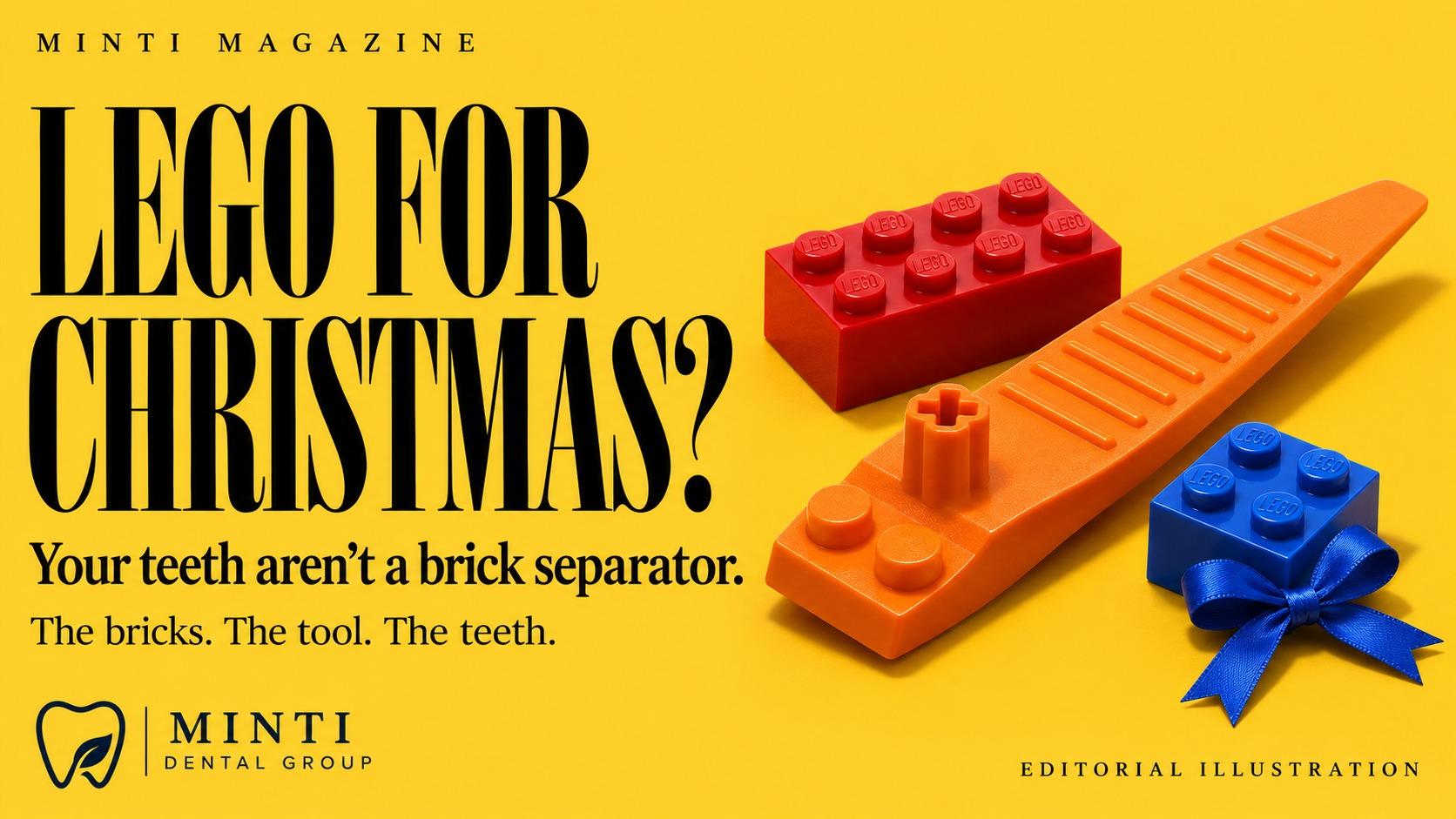
As a dentist, I have one plea for Christmas: use the separator.
The short answer: that little tool in the box? Your dentist would like you to use it. Lego's own brick separator is designed to pry apart plates, push out axles and lift tiles. Your teeth aren't. Using your teeth as tools can chip or crack them, and can damage existing dental work like fillings, crowns or bonding. The Oral Health Foundation has warned about exactly this kind of habit. So whether you're 7 or 47, pass the separator, not the plate, to your mouth. (If it's too late and a tooth has already chipped, here's what to do with a chipped or broken tooth.)
We all do it
Most of us use our teeth for jobs they were never meant to do.
In a survey for the Oral Health Foundation and Philips, 65% of people said they frequently use their teeth for tasks other than eating and drinking. The most common were tearing Sellotape, biting nails, carrying things, taking tags out of clothes, chewing pens and pencils, and opening bottles.
Prising apart Lego bricks didn't make that list, but anyone who's ever built a set knows it should have.
The habit was most common among younger adults, but it's worth knowing that children copy what they see. If the grown-ups at the table are biting bricks apart, the kids will too.
Why teeth make terrible tools
Your teeth are designed for biting and chewing food, with forces spread across the teeth in a particular way. They're incredibly strong at that job.
But they're not designed for twisting, levering, prising or gripping hard plastic at awkward angles. When you use your front teeth like pliers, you put force on small edges and corners that aren't built to take it.
Dr Nigel Carter, Chief Executive of the Oral Health Foundation, put it clearly: "Anything from opening bottles to chewing foreign objects can damage existing dental work or cause our teeth to crack." He also warned of teeth "chipping, and in some cases breaking."
Lego bricks are small, hard and very tightly fitted. That's what makes them so good. It's also what makes them a risky thing to bite down on.
Check-Ups and Hygiene at Minti
A private check-up is £35 to £38 and a hygiene visit is £60 to £76. On the NHS, a check-up is Band 1, £27.90.
Book a check-up
What can go wrong
Chips
The most common injury from using teeth as tools is a chipped front tooth. A corner breaks off, and suddenly your tongue can't leave it alone. Small chips can often be repaired with composite bonding (here's how long composite bonding lasts), but it's much better not to need it.
Cracks
Not every injury is visible. Biting hard on something can leave a crack you can't see, but can feel when you bite down or have a cold drink. Some cracks are harmless surface lines, called craze lines. Others go deeper and need treatment.
Damaged dental work
If you've got fillings, crowns, veneers or bonding, they can be especially vulnerable. Bonding on the edges of front teeth can chip. Crowns can come loose. Fillings can crack. And if a crown does come off, here's what to do if you've lost a crown.
Children's teeth
Children's baby teeth have thinner enamel than adult teeth, and new adult front teeth are still settling in. A chip in a child's tooth is something to get checked, even if it seems small. Here's what children's dentistry involves.
How to use the brick separator properly
This is the fun bit. The brick separator is the little tool that comes in many Lego sets, and it's cleverer than people think. According to Lego's own guide, it can do four jobs.
Taking plates off the top of studs. Press the front part of the separator down on top of two studs of the plate. Then press down on the back of the separator, using the ridges for grip, and the plate pops off.
Taking plates off from underneath. Press the two studs at the front of the separator up underneath the plate. Then press up on the back of the separator to release it.
Pushing out axles. The top of the separator has a small "T" shape, like a tiny Technic beam. Line it up with the cross hole, then press so the "T" pushes the axle through.
Lifting tiles. Use the edge of the separator that says "LEGO" on it. Slide it in where the tile meets the studs, then press down on the opposite side like a lever.
Lego also suggests making sure the rest of your build isn't moving while you do it. Which, as anyone who's tried to separate two pieces from the middle of a spaceship knows, is excellent advice.
If your set didn't come with a separator, or it's disappeared down the back of the sofa, they're inexpensive to replace. A lot cheaper than repairing a tooth.
Other teeth-as-tools habits to break this Christmas
Christmas is peak season for using our teeth for the wrong jobs. While you're at it, try not to use them to:
- open bottles or ring pulls
- rip open crisp packets, sweet wrappers or blister packs
- tear Sellotape while wrapping presents
- take tags off new clothes
- crack nuts
- hold things when your hands are full
Keep a pair of scissors and a bottle opener handy. Your teeth will thank you.
New Patient Consultations
A new patient consultation is £45 at our Harlow practices and £35 at Enfield Smiles. Every practice offers NHS and private care.
Request an appointment
If you do chip a tooth
Despite our best efforts, accidents happen. If you or your child chip a tooth:
- Find the broken piece if you can. NHS guidance suggests keeping a large broken piece in milk or saliva and bringing it to the dentist.
- Rinse gently with warm water.
- Take paracetamol or ibuprofen if it hurts, following the packet instructions.
- Avoid biting on the tooth, and avoid very hot or cold food and drink.
- Book a dental appointment. If it's very painful, a large piece has broken off, the tooth is loose or has moved, or you can see pink in the middle of the tooth, get seen urgently. Here's what counts as a dental emergency.
A few quick questions
Can you chip a tooth on Lego? Yes. Using your teeth to pull apart hard, tightly fitted pieces like Lego bricks can chip or crack teeth, or damage existing dental work.
How do you separate Lego bricks without your teeth? Use the brick separator. Lego's guide shows how it can lift plates from the top or bottom, push out axles and lift tiles.
Is it bad to use your teeth as tools? Yes. The Oral Health Foundation warns that using teeth for tasks like opening bottles can crack or chip them, and damage dental work.
What should I do if I chip a tooth? Keep any broken piece in milk or saliva, avoid biting on the tooth, take painkillers if needed, and book a dental appointment.
The verdict
Lego is one of the best presents going, for children and grown-ups alike. Just don't let it become a dental emergency on Boxing Day.
That little tool in the box is there for a reason. Use it, teach your kids to use it, and leave your teeth for the turkey. Your dentist would very much like to see you in the new year for a check-up, not a chipped tooth.
This article is general information based on public reporting. It is not personal dental advice. The LEGO Group and The Guardian have no connection with this article.