- Front tooth
- £325
- Premolar
- £375
- NHS Band 2
- £76.60
Root canal treatment
Treatment that saves an infected tooth and ends the pain.
Treatment that saves an infected tooth and ends the pain.
Front tooth from
£325
NHS: Band 2, £76.60
Choose your practice
NHS: Band 2, £76.60
Practices offering root canal treatment
Choose your practice to see its prices and book.
- Front tooth
- £325
- Premolar
- £375
- NHS Band 2
- £76.60
- Front tooth
- £325
- Premolar
- £375
- NHS Band 2
- £76.60
Quick answers
Can I drive home afterwards?
Usually, yes, if you only had local anaesthetic and feel well. Different rules apply if you had sedation, and the practice tells you what to arrange.
How much does private root canal treatment cost?
At Minti it costs £325 for a front tooth, £375 for a premolar and £475 for a molar. A crown, if needed, is quoted separately, as are retreatment and referred cases.
Bleeding gums are worth a check
Bleeding when you brush or floss is one of the first signs of gum disease. A hygiene visit checks your gums and removes the tartar that brushing can’t shift.
Book a hygiene visit
Root canal treatment at Minti
Everything you need to know about root canal treatment
Why a tooth needs root canal treatment
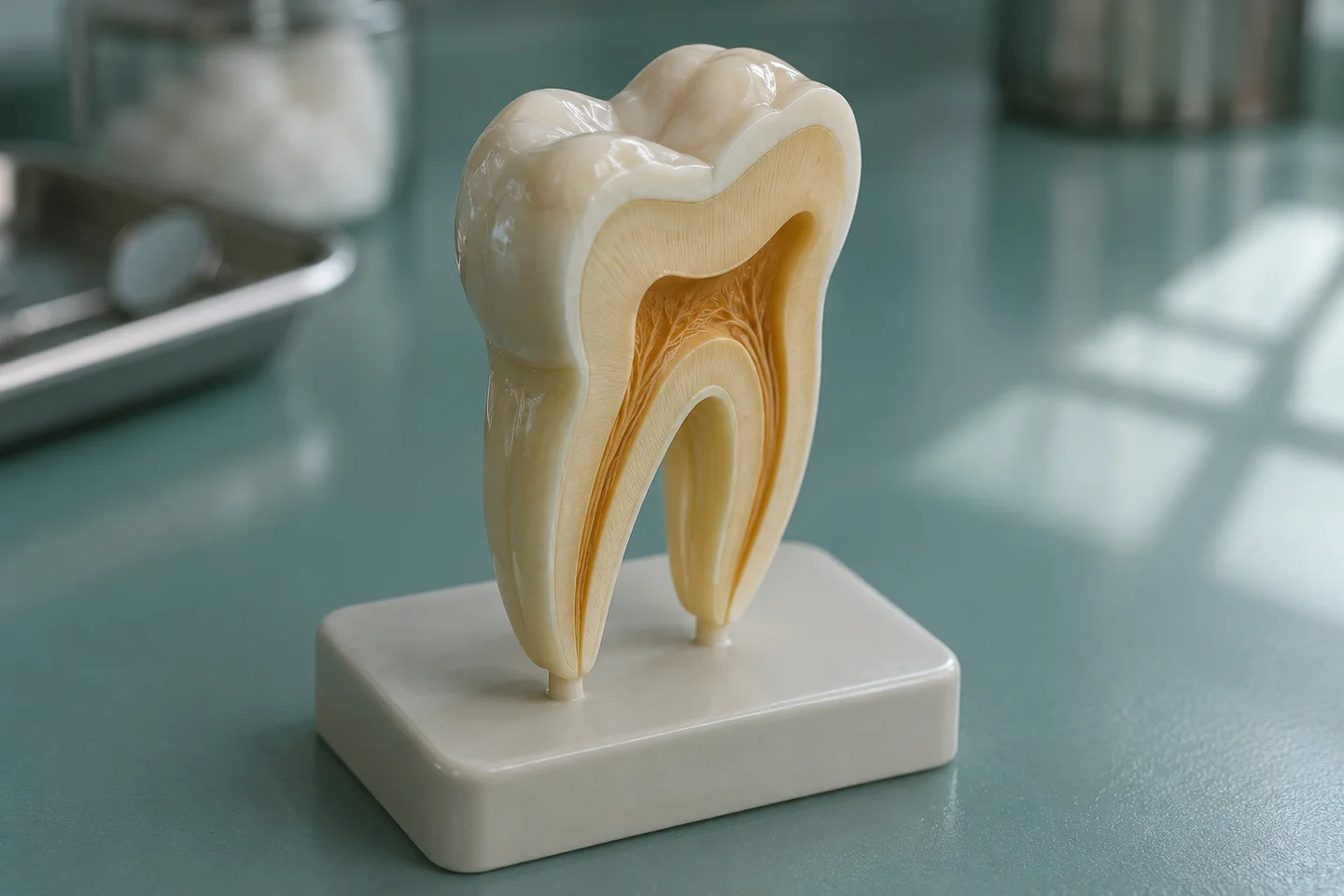
Inside every tooth is the pulp, soft tissue containing nerves and blood vessels that runs from the centre of the tooth down narrow canals in each root. When the pulp becomes infected or inflamed beyond the point where it can recover, it can cause pain and lead to infection around the root tip. Root canal treatment removes that tissue, cleans and disinfects the canals, then fills and seals them. A tooth that is properly restored afterwards can keep working without its pulp.
Common causes include:
- Deep decay that has reached the pulp through the outer layers of the tooth.
- A crack or fracture that lets bacteria into the inner tissue.
- Repeated or extensive fillings on the same tooth.
- A knock or injury, which can damage the pulp even when the tooth looks intact.
- An existing infection spreading to the tissue around the root and causing a dental abscess.
Symptoms such as persistent toothache, pain when biting, sensitivity to hot or cold that lingers, a recurring gum boil or a tooth turning darker suggest the tooth should be checked. They do not prove you need a root canal, and some infected teeth cause no pain at all and are found on an X-ray. Your dentist examines the tooth and may run tests or take an X-ray before recommending treatment.
Saving the tooth
If a tooth can be cleaned properly and rebuilt, keeping it is usually worth it. Before we recommend root canal treatment over an extraction, we check the canals, how much sound tooth is left and the gum and bone around it. Back teeth take longer because they have more canals.
Signs you might need an assessment
An examination helps your dentist find the cause and check whether the tooth can be saved.
- Persistent toothache
- Sharp pain when biting
- Sensitivity to hot or cold that lingers
- Tenderness or swelling near a tooth
How root canal treatment works
- AssessmentYour dentist examines the tooth, usually takes an X-ray and explains the diagnosis, the options and the fee.
- CleaningWith the tooth numbed and isolated, the dentist removes the affected pulp and cleans and disinfects the canals.
- SealingThe canals are filled and sealed. Between visits, a dressing and temporary filling protect the tooth.
- RestorationA permanent filling or crown seals and protects the tooth so it can be used normally again.
Root canal treatment or extraction
Keeping your own tooth is usually worthwhile when it can be treated and restored reliably. Your dentist checks whether the canals can be cleaned properly, whether enough sound tooth is left to rebuild and whether the gum and bone can still support it.
Root canal treatment may not be the best option when a tooth is split or badly fractured, has too little structure left for a lasting restoration, has lost much of its supporting bone, or cannot be treated predictably for another reason.
Keeping the tooth avoids a gap, but the tooth then needs a filling or a crown to protect it, and treatment can occasionally fail and need further care.
Removing the tooth deals with the problem in one step but leaves a space. Depending on where it is, you might leave it, or fill it with a denture, a bridge or a dental implant. Not every gap needs filling, and our tooth extraction page explains what removal involves.
Your dentist explains what the examination shows, the outlook for the tooth and the cost of each option before you decide.
Appointments and comfort
Root canal treatment often takes two or more appointments, although some teeth are finished in one. Front teeth often have a single canal, while molars can have three or four, so back teeth tend to take longer. Appointments commonly last one to two hours, and fitting a crown afterwards adds at least one more visit.
The tooth is numbed with local anaesthetic, and a thin rubber sheet called a dam is placed around it to keep it dry and clean. You may feel pressure or vibration, but treatment should not be painful. A badly inflamed tooth can be harder to numb, so tell your dentist if you feel anything and they can give more anaesthetic.
If you feel anxious, mention it when you book. Our page on help for nervous patients explains the support the practices offer.
Aftercare and recovery
- While you are numbThe anaesthetic can take a few hours to wear off. Avoid chewing and hot drinks until feeling returns, so you do not bite your cheek or tongue.
- TendernessThe tooth may feel sore for a few days while the surrounding tissue settles. Paracetamol or ibuprofen can help if they are suitable for you.
- Temporary fillingsAvoid biting hard food on the tooth and contact the practice if the temporary filling breaks or falls out.
- The final restorationThe tooth needs a permanent filling or a crown to seal and protect it. Back teeth take heavy chewing forces and often need a crown. Do not put this off without talking to your dentist, because an unprotected tooth can crack.
- Routine careBrush twice a day with fluoride toothpaste, clean between your teeth and keep up your dental check-ups. Your dentist may take a follow-up X-ray to check healing.
Contact the practice urgently if pain is severe or getting worse, swelling increases or you develop a fever. Swelling that makes it hard to breathe, swallow or speak needs 999 or A&E.
How long a root-treated tooth lasts
Many root-treated teeth keep working for years, especially when the treatment succeeds and the tooth has a good final restoration. No treatment can promise a tooth for life. The outlook depends on the condition of the tooth before treatment, the shape of its canals, the health of the gum and bone, the quality of the restoration and how well the tooth is looked after.
A root-treated tooth can still decay, crack or become infected again. If that happens, repeat root canal treatment, referral to a dentist with more experience in root canal work, or removal may be considered. Some treated teeth also darken over time, and your dentist can discuss options such as internal whitening or a crown.
Teeth with unusual canals, previous root canal treatment or other complications may be referred. Your dentist explains whether your tooth can be treated at the practice and, if not, how referral works on the NHS or privately.
Before you book
- Describe the tooth and the pattern of painTell reception about recent fillings, a bad taste, swelling or pain when biting. Bring the treatment notes if you have already been seen elsewhere.
- Ask what is involved in keeping the toothDiscuss how the tooth will be restored after treatment, whether more visits are needed and what your options are if the tooth cannot be retained.
NHS and private root canal fees
Published fees at all three Minti practices. The private fee depends on the tooth, and your dentist confirms the treatment and the fee before it starts.
| Treatment | NHS | Private at Minti |
|---|---|---|
| Front tooth (incisor or canine) | Band 2, £76.60 | £325 |
| Premolar | Band 2, £76.60 | £375 |
| Molar | Band 2, £76.60 | £475 |
| Root canal with a crown in the same course | Band 3, £332.10 | Crown quoted separately |
| Urgent treatment to relieve pain | Urgent, £27.90 | On request |
NHS charges cover the whole course of treatment, not each visit. If a crown is needed on the NHS in the same course, you pay the Band 3 charge rather than Band 2 on top. The urgent charge can cover starting root canal treatment to relieve pain, but completing it is usually a separate Band 2 course. Some people get free NHS treatment or help with costs. Retreatment and referred cases are quoted separately.
All fees and finance optionsA written quote before you decide
Your practice explains your options and confirms the cost before treatment starts.
Request an appointment
What patients say
- ★★★★★
My dentist was very thorough and communicated with me well about my teeth. Highly recommend.
Tamara B. · Nuffield
- ★★★★★
There’s no other dentist like this one.
Aidan R. · Church Langley
- ★★★★★
Fantastic, thanks for looking after me, even though I got to my appointment late.
Thomas W. · Enfield Smiles
Frequently asked questions
Does root canal treatment hurt?
It is done under local anaesthetic, so you should feel pressure or vibration rather than pain. A very inflamed tooth can be harder to numb, so tell your dentist if you feel anything and they can give more anaesthetic.
Can a root canal save a badly infected tooth?
Often, yes. Root canal treatment is designed to clear infection from inside the tooth. It depends on whether the canals can be cleaned properly and enough tooth is left to restore. Some teeth cannot be saved and need removing.
Do I need antibiotics for an infected tooth?
Usually not. Root canal treatment removes the source of the infection. Antibiotics are only needed in particular cases, such as an infection that is spreading or making you unwell. Seek urgent advice if swelling grows or you develop a fever.
Is root canal treatment available on the NHS?
Yes, when it is clinically needed. It is part of the Band 2 charge of £76.60 in England, or Band 3 at £332.10 if a crown is needed in the same course. Ask your chosen practice about NHS availability.
Request an appointment
Send a request and your practice will call to confirm a time.
Booking at Nuffield · 01279 424 038