You've felt the zing. A sharp little jolt on one tooth when you bit into something, gone as fast as it came. Since then you've been chewing on the other side, prodding the tooth with your tongue, and peering at it in the bathroom mirror with your phone torch. Maybe you can see a line. Maybe you can't see anything at all, which is somehow worse. You're not imagining it, and you're not the only one. Cracked teeth are one of the most common things I hear about in my surgery.
The short answer: most cracked teeth can be saved. What's needed depends on the type of crack: craze lines need nothing, small cracks can be bonded or filled, deeper cracks usually need an onlay or crown, and root canal treatment is added if the crack reaches the nerve. A tooth that has split, or cracked below the gum or into the root, usually needs to come out. Cracks don't heal on their own, so the earlier I see it, the more options there are. If it hurts now, call my emergency dentist team in Harlow or Enfield, or NHS 111 if we're closed or you're not local. If it's a line you've spotted with no pain, a check-up is the place to start.
Think you've cracked a tooth? Chew on the other side until it's been looked at. If a piece has come off, keep it in milk or saliva and bring it with you. Ring your nearest Minti practice, and if it's painful, tell reception it's urgent. I keep same-day appointments for pain and swelling wherever I can.
- Nuffield Dental Practice, Harlow: 01279 424 038
- Church Langley Dental, Harlow: 01279 306 690
- Enfield Smiles, Enfield: 020 8804 4320
Evening, weekend, or nowhere near us? Call NHS 111. If you're struggling to breathe or swallow, or swelling is spreading to your eye or neck, that's 999 or A&E.
What are the different types of cracked tooth?
"Cracked tooth" covers everything from a harmless line to a tooth in two pieces, so the first thing I do is work out which kind you've got. The American Association of Endodontists (AAE), the root canal specialists, sorts them into five types, and I use them as a map:
- Craze lines: tiny lines in the outer enamel. Painless, and no treatment needed unless you don't like the look.
- Fractured cusp: a corner of the chewing surface breaks off, often around a filling. Usually fixed with a new filling or crown.
- Cracked tooth: a crack from the biting surface down towards the root. Usually needs a crown, plus root canal treatment if it has reached the nerve.
- Split tooth: a cracked tooth that has gone all the way through into separate pieces. It can't be saved whole.
- Vertical root fracture: a crack that starts in the root. Often means extraction.
The deeper the crack, the more work it takes and the lower the odds. That's the thread running through everything below.
Craze lines on teeth: are they harmful?
Those faint vertical lines you notice in certain light, usually on front teeth, are very often craze lines. The AAE says they only affect the outer enamel and are of no concern beyond appearance. Tea and coffee can stain them, which is why they suddenly seem obvious.
Craze lines vs a cracked tooth: how can you tell?
The biggest clue is pain. Craze lines don't hurt; a true crack usually does, typically a sharp pain on biting or with cold. A line you can see isn't always the one that matters, though, and the one that matters often can't be seen at all.
Hairline crack in a tooth: should you worry?
"Hairline" describes how thin the crack looks, not how deep it goes. A fine line can be a harmless craze line or the top of a deeper crack. If a tooth with a hairline crack hurts on biting, I'd want to see it.
How do you know if a tooth is cracked?
Cracks are the master criminals of dentistry. They come and go, they're hard to pin to one tooth, and they rarely show up on an X-ray. So I rely on the story you tell me, a bite test one cusp at a time, and a bright light shone through the tooth.
Cracked tooth symptoms
The classic signs are a sharp pain when you bite, often on something grainy, a jolt when you let go, and sensitivity to cold that stops quickly. The pain is often on and off, which tempts people to wait.
Cracked tooth syndrome: what is it?
Cracked tooth syndrome is the name for that pattern of sharp, fleeting pain on biting from a crack you often can't see. The name sounds dramatic; it just means a cracked tooth that's causing symptoms.
Tooth hurts when you release your bite
Pain as you let go of a bite, rather than as you bite down, is one of the more specific clues for a crack.
Cracked molar: why back teeth crack
Back teeth crack more than any others. They take the most force, and the cusp of the tooth above can wedge into the grooves of the one below. Lower molars are the most commonly affected.
What makes teeth crack?
The Oral Health Foundation lists the usual culprits: grinding or clenching, large fillings that weaken the tooth, and biting on hard things like ice, fruit stones, bones or hard sweets. Usually it's a combination, and the final bite just finishes a job that started long before.
Cracked a tooth on popcorn, ice or a nut
The unpopped kernel, the ice cube, the olive stone. One bite and something's not right.
Cracked filling
A big filling leaves thinner walls of tooth around it, and sometimes it's the filling that cracks, sometimes the tooth next to it. Either way it's worth getting looked at before food and bacteria get in.
Cracked or broken wisdom tooth
Wisdom teeth are molars too, and they crack and break in the same way. They come with their own complications, including whether it's worth saving at all.
Can a cracked tooth heal on its own?
No, and this is the one thing I'd like everyone to take away. The AAE and the Oral Health Foundation are both clear that, unlike a broken bone, a cracked tooth doesn't heal. It's more like a chip in a car windscreen: it can sit quietly for months, then one cold morning it runs right across. Home remedies might take the edge off for a while, but none of them will close the crack.
How is a cracked tooth treated?
Treatment is about stopping the crack spreading and protecting the nerve. The options run from a quick bit of bonding to a crown, root canal treatment or, when nothing else will work, extraction.
Cracked tooth repair: options and costs
Bonding, fillings, onlays, crowns, root canal treatment and extraction, and what each costs. On the NHS in England, fillings and root canal treatment are Band 2 (£76.60) and crowns, onlays, bridges and dentures are Band 3 (£332.10), as listed on nhs.uk when I checked on 8 October 2026. Private fees vary and should always be confirmed in writing first; our fees and finance page explains how it works at Minti.
Can a broken tooth be repaired with a filling?
Sometimes. A filling or bonding can seal a small crack or rebuild a chipped corner. But a filling fills a gap; it doesn't hold the walls of a tooth together, so a crack running across the tooth usually needs more.
Chipped or cracked front tooth
Front teeth are more about looks than chewing force, and tooth-coloured bonding is often the neatest fix for a small chip. Bigger breaks may need a veneer or crown.
Root canal on a cracked tooth: does it work?
Root canal treatment treats the nerve, not the crack. If the crack has reached the nerve, it can stop the pain and save the tooth, but the AAE's guidance is that a cracked tooth needs a crown to hold it together. Success falls the deeper the crack goes.
Can a cracked tooth be saved?
Usually. The AAE says most cracked teeth carry on working and give years of comfortable chewing once treated. But I'll keep this bit straight: some can't be saved, and pretending otherwise just costs you time and money.
Does a cracked tooth need to be pulled?
Mostly not. The AAE says a tooth usually can't be saved when the crack runs below the gum line, when the tooth has split, or when there's a vertical root fracture. If it does need to come out, I'll show you why first. See the tooth extraction page.
Tooth split in half vertically
A split tooth can't be saved whole. Sometimes part of a back tooth can be kept with root canal treatment and a crown; often it comes out. This one needs seeing promptly.
Tooth cracked and you can see inside it
If you can see into the tooth, or see a dark or pink area, the break may be close to the nerve. That changes how quickly I'd want to see you.
Tooth broke but doesn't hurt
No pain can mean the nerve is fine, or that it has already died. Either way, a broken tooth still needs checking before the crack grows. Please don't take no pain as the all-clear.
Replacing a tooth that can't be saved
If a cracked tooth does come out, the main replacements are a denture, a bridge or an implant. My guides to dentures, dental bridges and dental implants cover each one. At Minti, implant treatment is at our Harlow practices; the NHS says implants are usually only available privately.
When is a cracked tooth an emergency?
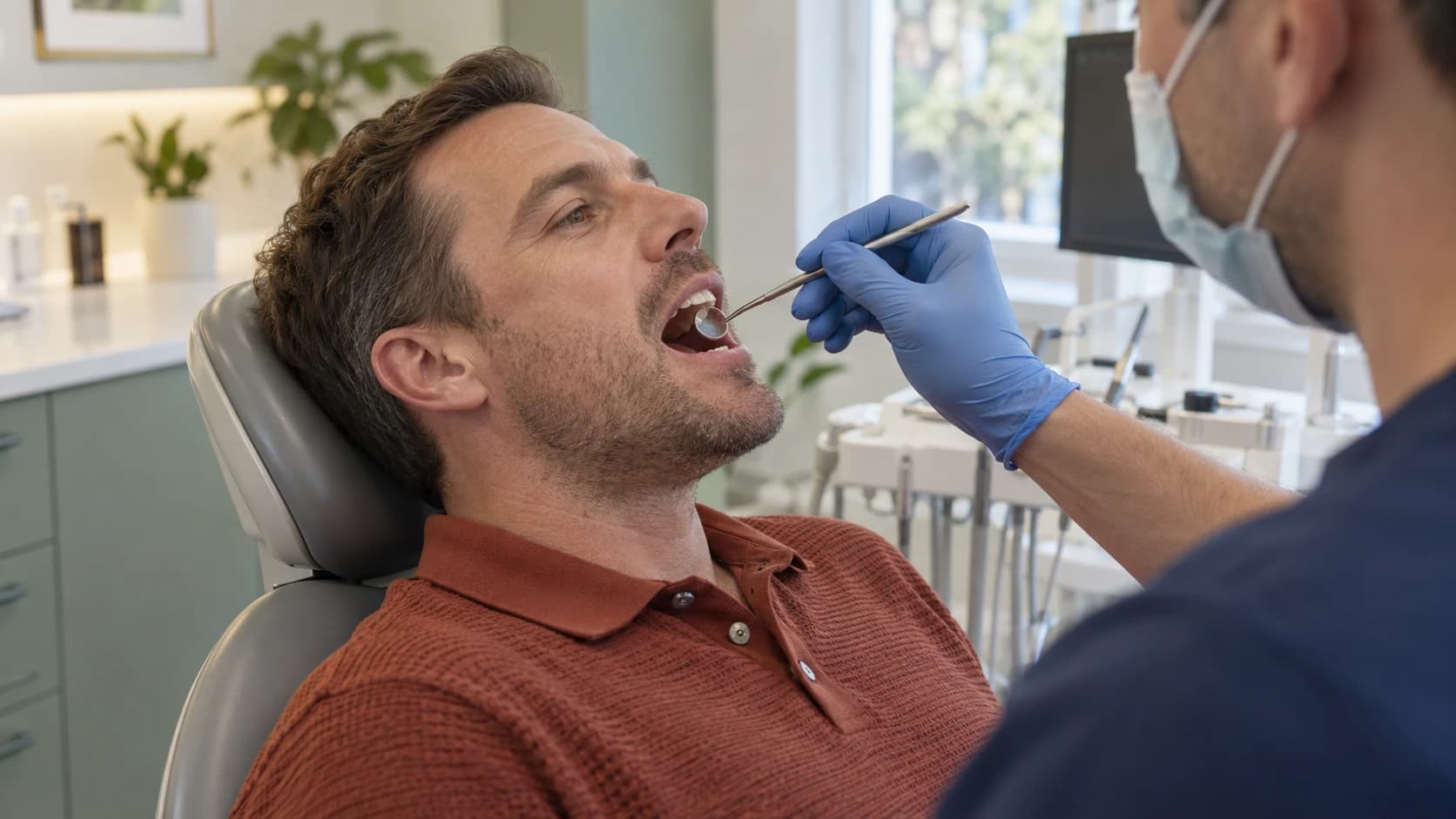
A craze line with no pain can wait for your check-up. A tooth that hurts when you bite shouldn't wait that long: book in now, while it's still a small repair. The visit is simple: a look, a bite test, a light through the tooth and an X-ray.
Call us today if:
- biting pain is getting worse, or you get a jolt when you release your bite
- pain lingers after hot or cold, throbs by itself or keeps you awake
- the tooth has split, feels like it moves in two parts, or a piece has come away
- there's swelling of the gum or face, a bad taste, or a temperature
Call 999 or go to A&E, not a dentist, if:
- you're finding it hard to breathe, swallow or speak
- swelling is spreading towards your eye or down into your neck
- your eye is swollen or painful, or your eyesight changes suddenly
- you can't open your mouth properly because of the swelling
Until you're seen, chew on the other side and take painkillers as directed on the pack if you need them.
If you're near Harlow or Enfield, I'd much rather take a look now, while there are still plenty of options, than have the crack make the decision for you. Ring your nearest Minti practice, tell us what you've noticed, and if it's painful, say it's urgent and we'll do our best to see you the same day. Anywhere else, or out of hours, call NHS 111.
This article is general information, not a diagnosis. A cracked tooth needs examining in person to find out how deep it goes and what it needs.