Maybe your tongue has found a rough edge that wasn't there last month. Maybe a cold drink made one tooth yelp. Maybe you've just spotted a dark mark in the mirror and spent ages angling your phone torch at it. Whatever brought you here, you're in good company. Tooth decay is one of the most common things I see in my surgery, and it's one of the most fixable, especially if it's caught early.
The short answer: tooth decay is damage to a tooth caused by acid from plaque bacteria feeding on sugar. The NHS lists the signs as white, brown or black spots, sharp pain with hot, cold or sweet things, and toothache, though early decay often causes no symptoms at all. Very early decay can sometimes be reversed with fluoride; once there's a hole, it usually needs a filling, and deeper decay may need root canal treatment or the tooth taking out. If nothing hurts, book a dental check-up. If you have pain or swelling, call my emergency dentist team in Harlow or Enfield, or NHS 111 if we're closed or you're not local.
Toothache, swelling or a bad taste? Call your nearest Minti practice and tell reception it's urgent. I keep same-day appointments for pain and swelling wherever I can.
- Nuffield Dental Practice, Harlow: 01279 424 038
- Church Langley Dental, Harlow: 01279 306 690
- Enfield Smiles, Enfield: 020 8804 4320
Evening, weekend, or nowhere near us? Call NHS 111.
Call 999 or go to A&E, not a dentist, if:
- you're finding it hard to breathe, speak or swallow
- swelling is spreading towards your eye or down into your neck, or there's a lot of swelling in your mouth
- your eye is swollen or painful, or your eyesight suddenly changes
- you can't open your mouth properly
What causes tooth decay?
Here's the thing: your teeth are under attack a little every time you have something sugary, and that's normal. The NHS explains that bacteria form a sticky layer called plaque on your teeth, and when you have sugary food and drink, that plaque damages the tooth surface over time. The Oral Health Foundation says each acid attack lasts about an hour.
Your saliva is the clean-up crew. Give it a break between attacks and it can repair tiny amounts of damage. Keep the attacks coming, a sip here, a nibble there, and the crew never gets to clock off. That's why how often you have sugar matters as much as how much.
None of this is about blame. Busy lives, long commutes, children, stress: plenty of reasons why routines slip. My job is to deal with what's there, not to tut about how it got there.
What are the signs of tooth decay?
The NHS lists these signs:
- white, brown or black spots on a tooth
- a hole in the tooth
- sharp pain when eating or drinking hot, cold or sweet things
- toothache
- in more severe cases, a painful build-up of pus (dental abscess)
The catch is that decay may not cause any symptoms at first. That's why check-ups catch so much of it: I'm looking for it before your tooth starts complaining.
What a cavity looks like
Cavities aren't always the obvious black hole people picture. Some are chalky patches, some are brown shadows, some hide between teeth.
Black spots
Not every dark mark is decay. Stains from tea, coffee and red wine can look very similar, and only an examination tells them apart.
What are the stages of tooth decay?
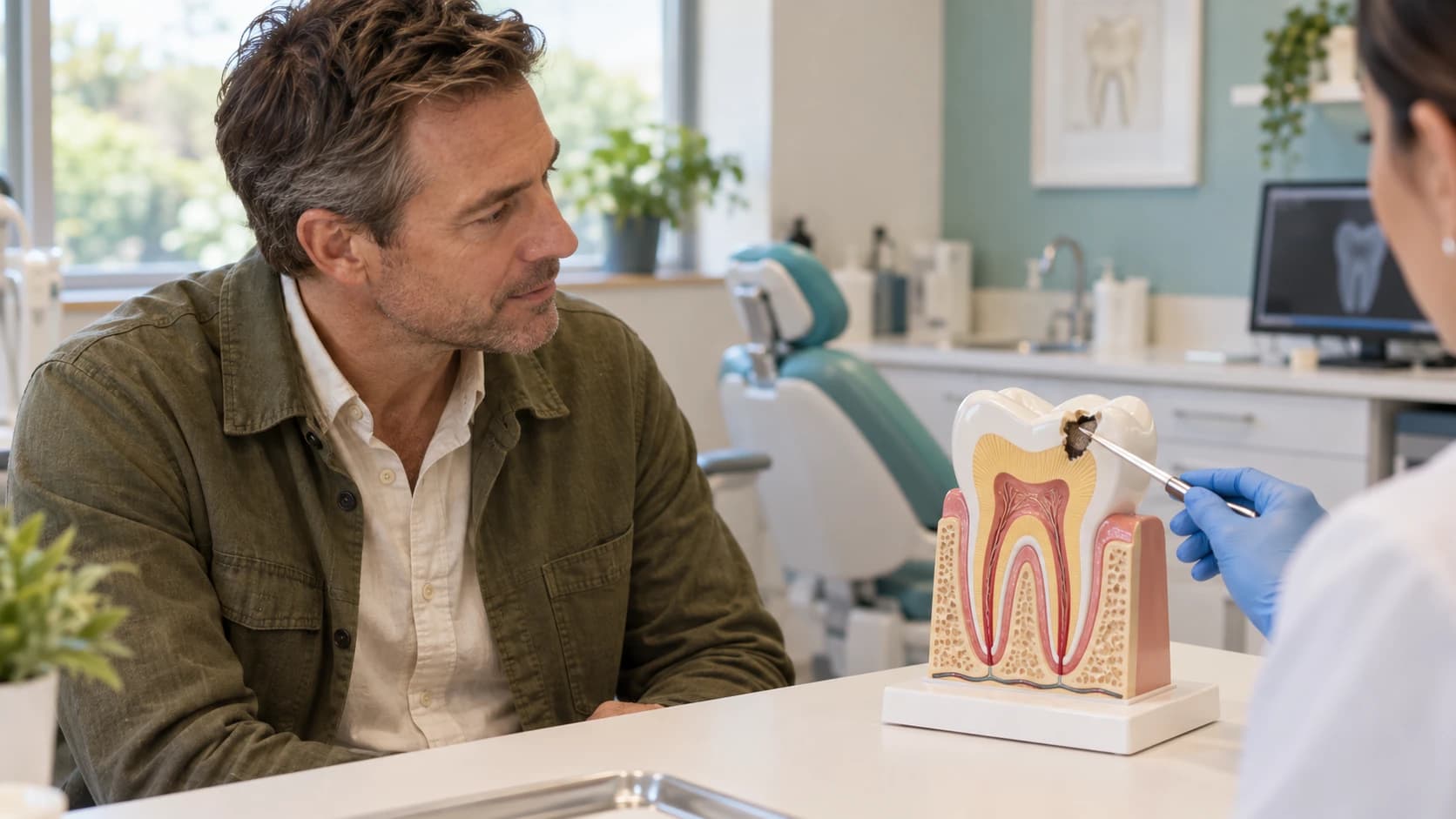
Decay works inwards through the tooth. The MSD Manual says it moves slowly through the hard outer enamel, speeds up in the softer dentine underneath, and causes damage that can't be undone once it reaches the pulp, the living centre with the nerve. From there, the NHS says it can lead to a dental abscess.
Think of it as a house: the enamel is the brickwork, the dentine is the plaster, and the pulp is where you live. Rain on the bricks is fine. Rain in the living room is a different conversation.
Early cavities
The very first stage, before the enamel surface breaks, is the one that can sometimes be turned around. The MSD Manual says enamel can repair itself at this point with fluoride, and the NHS says dentists can use fluoride varnish or mouthwash to reverse early decay.
What should you do if you find a hole in your tooth?
Get it looked at, even if it doesn't hurt. Once enamel has broken down, the MSD Manual says it can't repair itself, so the hole won't close on its own.
A small hole with no pain
No pain doesn't mean no problem; it often just means the decay hasn't reached the nerve yet, which is the best time to fix it.
Trying to remove it yourself
Please don't. Picking or scraping damages healthy enamel and leaves the decay underneath.
What happens if tooth decay isn't treated?
I'll keep this bit straight. Decay doesn't stop by itself. The NHS says it can lead to a dental abscess, the MSD Manual says an untreated cavity can ultimately lead to losing the tooth, and it says an untreated tooth infection may spread to the jaw or other parts of the body. That's why the urgent warning signs at the top of this page is there.
A rotten tooth
If a tooth has been decaying for a while, it can still often be saved.
Dental abscess
Throbbing pain, swelling, a bad taste or feeling unwell can mean infection, which the NHS says needs urgent treatment by a dentist. My dental abscess and tooth infection guide covers the warning signs and treatment.
A broken tooth
Decay weakens teeth, so they can crack or break.
A decayed tooth that fell out
Often part of the root is still in the gum.
How is tooth decay treated?
It depends on how far it's gone. The MSD Manual and the NHS describe it like this:
- Very early decay: fluoride treatment, such as varnish, and better protection at home.
- A cavity: a filling. I numb the tooth, remove the decay and seal it. Our fillings page describes white composite and silver amalgam options.
- Decay into the nerve: root canal treatment, often followed by a crown, or taking the tooth out if it can't be saved.
The appointment itself is straightforward: a few questions, a look, a couple of quick tests and an X-ray if needed. You can't tell how deep decay goes from the surface, and neither can Google. That's what the appointment is for.
Fillings
Types, what it feels like, how long it takes and how long it lasts are all in my guide to tooth fillings.
Decay under a crown
Crowned teeth can still decay at the edges, and it's harder to spot.
On cost: our NHS dentist and fees and finance pages explain what's available. Private fees vary, and we confirm them in writing before any treatment.
What about tooth decay in children?
Children get decay in the same way adults do, and baby teeth matter: the MSD Manual says losing them early to decay can let neighbouring teeth shift. The NHS says NHS dental care is free for children and recommends fluoride varnish from the age of 3. Our children's dentistry page explains what we offer.
How can you prevent tooth decay?
Delivering Better Oral Health, the government's prevention toolkit for dental teams, is what I follow, and for adults it comes down to this:
- Brush at least twice a day with a fluoride toothpaste of 1,350 to 1,500ppm, including last thing at night.
- Spit, don't rinse, so the fluoride stays on your teeth.
- Cut down how much and how often you have sugary food and drinks, and avoid them at bedtime.
The NHS also suggests cleaning between your teeth and having regular check-ups. If you're at higher risk, I may suggest extra fluoride, such as varnish or a stronger prescription toothpaste. That's the advice I give in the chair, and none of it involves anything more complicated than a toothbrush and a bit of timing.
When should you see a dentist about tooth decay?
As soon as you notice a sign, even if it doesn't hurt. The earlier decay is caught, the smaller the fix tends to be.
Call us today if:
- a tooth is throbbing, keeping you awake or hurts to bite on
- pain lingers after hot or cold, or comes on by itself
- you have swelling in your gum or face, a bad taste or pus
- you feel unwell or feverish alongside toothache
- a tooth has broken or come out
And anything in the urgent warning signs at the top (trouble breathing, speaking or swallowing, swelling spreading to your eye or neck, or not being able to open your mouth) is 999 or A&E, not a dentist.
While you wait, the NHS suggests painkillers such as paracetamol or ibuprofen (following the packet dose; ibuprofen isn't suitable for everyone), soft foods, and avoiding very hot or cold food and drink.
If you're near Harlow or Enfield and a tooth has been on your mind, I'd much rather take a look than have you keep checking it with your tongue and hoping. Ring your nearest Minti practice today. Anywhere else, or out of hours, call NHS 111.
This article is general information, not a diagnosis. Tooth pain and decay need examining in person to find the cause.