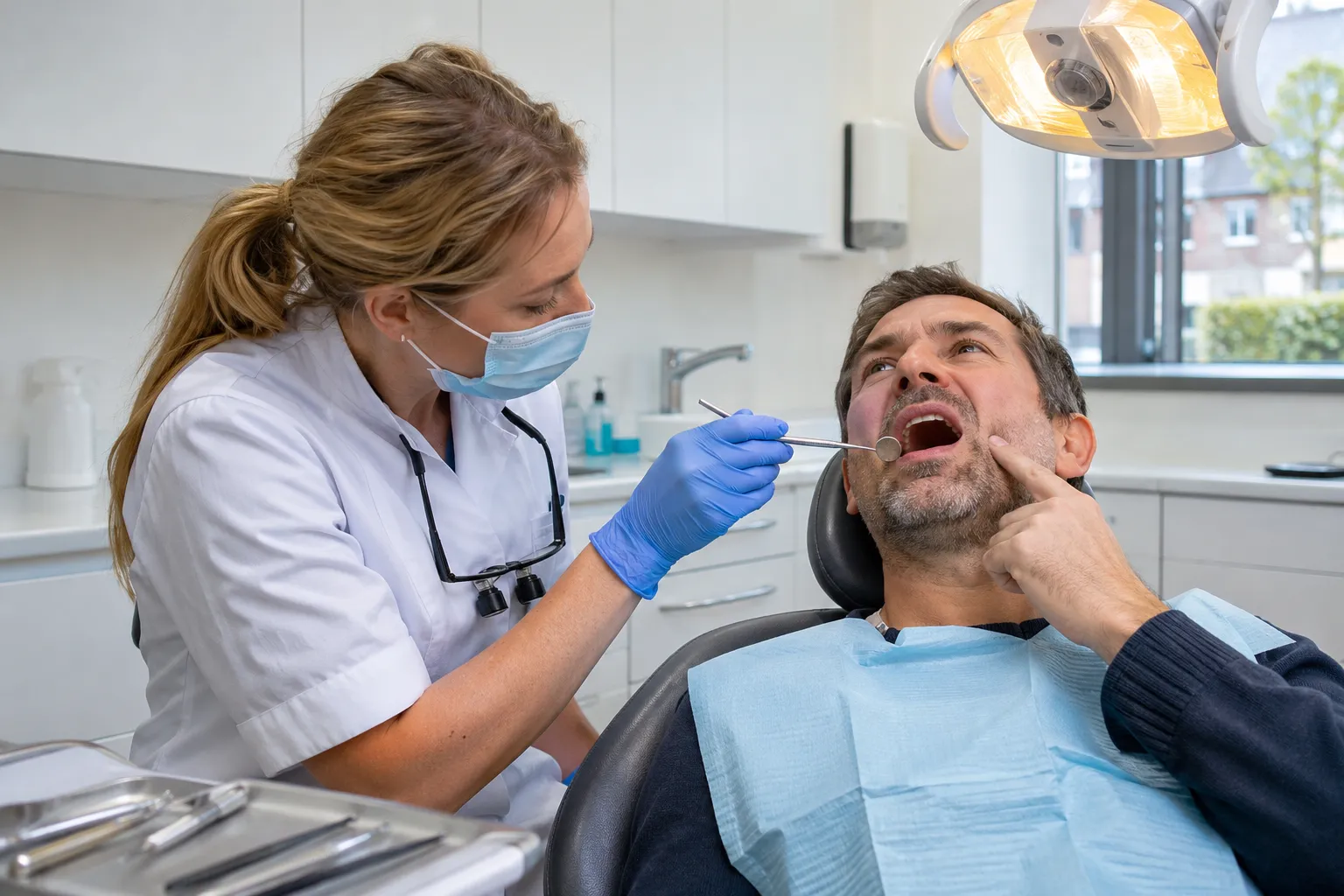
Something's changed, hasn't it? Maybe your tongue keeps wandering back to a rough patch. Maybe the first sip of an iced coffee now comes with a little zing on one side, so you've quietly started drinking out of the other side of your mouth like a secret agent. You're wondering whether this is a filling waiting to happen. You're not imagining it, and you're not the only one: it's one of the most common reasons people book in to see me.
The short answer: the common symptoms of tooth decay are a quick, sharp twinge with sweet, hot or cold things, a hole or rough spot you can feel or see, food catching in one place, and white, brown or black spots on the tooth. Toothache comes later, when decay gets close to the nerve. But early decay often has no symptoms at all, so you can't rule it out just because nothing hurts. If you've noticed any of these signs, book a dental check-up; if it's a cavity, a filling is the usual fix, and small decay usually means a small one. If you have toothache that lingers, swelling or a broken tooth, call my emergency dentist team in Harlow or Enfield, or NHS 111 if we're closed or you're not local.
Noticed a twinge, a rough spot or a hole? Ring your nearest Minti practice and book a check-up. If it's become toothache, or there's swelling or a broken tooth, tell reception it's urgent. I keep same-day appointments for pain and swelling wherever I can.
- Nuffield Dental Practice, Harlow: 01279 424 038
- Church Langley Dental, Harlow: 01279 306 690
- Enfield Smiles, Enfield: 020 8804 4320
Evening, weekend, or nowhere near us? Call NHS 111. If you're struggling to breathe or swallow, or swelling is spreading to your eye or neck, that's 999 or A&E.
What are the first signs of tooth decay?
Often, nothing you'd notice. The NHS says tooth decay may not cause any symptoms at first, and while it's only in the enamel, the outer shell of the tooth, it doesn't hurt. Enamel has no nerves, so it can't complain. It's like a burglar working on the front door while the alarm is still in the box.
The one early clue you might spot is a chalky white patch that looks duller than the rest of the tooth. That's enamel losing minerals to acid. At this stage it may not need a filling at all, because early decay can often be stopped with fluoride. I explain that in early cavity: can it be reversed?, and there are pictures-in-words of each stage in what does a cavity look like?
This is exactly why I bang on about check-ups. Decay is quiet at the stage when it's easiest to deal with.
Which symptoms mean decay has gone deeper?
Once decay gets through the enamel into the dentine, the softer layer underneath, things tend to change. Dentine is connected to the nerve, so the tooth starts to notice. Signs I'd take as a nudge to book in:
- A short, sharp twinge with sweet, hot or cold food and drink, which fades once the trigger's gone. Sweet sensitivity in one tooth is a classic; I cover it in why does chocolate make my tooth hurt?
- A hole, dip or rough edge your tongue keeps finding. See hole in your tooth: what should you do?
- Food or floss catching in the same spot, or floss that shreds between two particular teeth.
- A brown, grey or black spot that's new or getting bigger. It could be a stain rather than decay, which I explain in black spot on a tooth: decay or stain?
Here's the thing: none of these on their own proves it's decay. Sensitivity has plenty of other causes, like gums pulling back or worn enamel. But any of them is enough reason for a proper look, and that's the advice I give in the chair.
Can tooth decay cause toothache?
Yes, and I'll keep this bit straight. When decay reaches or gets close to the pulp, the soft centre of the tooth with the nerve and blood supply, the pain usually changes character. Instead of a quick twinge that goes, you might get:
- pain that lingers after hot or cold, rather than fading in a few seconds
- toothache that starts on its own, or keeps you awake at night
- a throbbing ache, or pain when you bite
If it goes further, the tooth can become infected and form a dental abscess, which the NHS lists as a possible result of decay. Signs include swelling, a bad taste or pus. More in my guide to dental abscess and tooth infection.
One trap to know about: sometimes the pain from a badly decayed tooth eases off for a while. That isn't necessarily good news. Please don't take a quiet spell as the all-clear if the tooth was hurting properly before.
Does every sign of decay mean you need a filling?
No, and I think that's worth knowing before you walk in. What I'd suggest depends on how far the decay has got, and the NHS lists the options:
- Early decay, no hole: fluoride treatment, such as varnish or mouthwash, plus some changes at home, to help the enamel harden up again.
- A cavity: a filling. It's the bread and butter of dentistry. If you're nervous, do fillings hurt? walks you through what it feels like, and how much is a filling on the NHS? covers cost.
- Decay that's reached the nerve: root canal treatment, often followed by a crown.
- A tooth too broken down to save: removing it.
The pattern is simple: the earlier it's found, the smaller the fix. My guide to tooth fillings has more on types and how long they last, and the whole decay story is in my guide to tooth decay.
You can't tell which of these you need from your sofa, and neither can Google. At a check-up I'll ask what you've noticed, look closely at the tooth and take an X-ray if it's needed, which usually gives us an answer in one visit.
When should you see a dentist about decay symptoms?
Book a check-up soon if you've noticed a quick twinge with sweet, hot or cold, a rough patch or hole, food catching, or a new spot on a tooth. It isn't an emergency, but it won't fix itself once there's a hole.
Call us today, and say it's urgent, if:
- the pain lingers after hot or cold, comes on by itself or keeps you awake
- it hurts to bite on the tooth
- a piece of the tooth has broken off (see broken tooth or lost filling)
- your gum or face is swollen, or there's a bad taste or pus
Call 999 or go to A&E, not a dentist, if:
- you're finding it hard to breathe, swallow or speak
- swelling is spreading towards your eye or down into your neck
- your eye is swollen or painful, or your eyesight suddenly changes
- you can't open your mouth properly because of swelling
Until you're seen, the NHS advice is to brush at least twice a day with fluoride toothpaste, spit rather than rinse, and keep sugary food and drinks to a minimum.
If you're near Harlow or Enfield, I'd much rather take a look now, while it might be a small filling, than have you chewing on one side for the next six months. Ring your nearest Minti practice to book. If it's turned into proper toothache, say it's urgent and we'll do our best to see you the same day. Anywhere else, or out of hours, call NHS 111.
This article is general information, not a diagnosis. Tooth symptoms need examining in person to find the cause.