You've had your phone torch out, haven't you? Mouth wide open in the bathroom mirror, head tilted like a curious dog, trying to work out whether that little mark on your back tooth is a cavity or last night's curry. Then you've Googled it, and every picture looks either nothing like yours or exactly like yours. You're not imagining things, and you're not the only one. "Is this a cavity?" is one of the most common things I hear in my surgery.
The short answer: an early cavity often looks like a chalky white spot on the tooth. As decay goes on, it can turn brown or black, and eventually you may see or feel an actual hole, often one that catches food. The catch is that many cavities can't be seen in a mirror at all, especially between teeth or under old fillings, and early decay usually doesn't hurt. The only reliable way to know is a proper look, so book a dental check-up. If it does turn out to be a cavity, our fillings page explains how we repair it, and I cover the whole picture in my guide to tooth decay. If you have toothache, swelling or a broken tooth, that's different: call my emergency dentist team in Harlow or Enfield, or NHS 111 if we're closed or you're not local.
Spotted something, or not sure what you're looking at? Ring your nearest Minti practice and book a check-up. If there's pain, swelling or a broken tooth, tell reception it's urgent. I keep same-day appointments for pain and swelling wherever I can.
- Nuffield Dental Practice, Harlow: 01279 424 038
- Church Langley Dental, Harlow: 01279 306 690
- Enfield Smiles, Enfield: 020 8804 4320
Evening, weekend, or nowhere near us? Call NHS 111. If you're struggling to breathe or swallow, or swelling is spreading to your eye or neck, that's 999 or A&E.
What does an early cavity look like?
Usually not like a hole at all. The earliest stage of decay tends to show up as a dull, chalky white patch on the enamel, a bit less shiny than the tooth around it. The NHS lists white, brown or black spots on a tooth among the signs of decay.
Here's what's going on. The bacteria in plaque turn sugar into acid, and the acid draws minerals out of the enamel. The surface is still there, but it's gone soft and porous underneath. Think of a biscuit that's been dunked a bit too long: it still looks like a biscuit, but it's lost its crunch.
This is the stage I most like to catch, because it's the one with the best news attached. Early white-spot decay can often be stopped and the enamel can harden up again with fluoride, before it ever becomes a hole. I explain how in early cavity: can it be reversed?
What does a cavity look like as it gets bigger?
Once the softened enamel gives way, you get an actual cavity. You might notice:
- a brown, grey or black area, often in the grooves on the biting surface of a back tooth
- a small dip, pit or hole you can see, or feel with your tongue
- food that keeps catching in the same spot
- a rough or sharp edge where a bit of tooth has crumbled away
One thing that surprises people: what you can see on the surface often understates what's underneath. Decay moves slowly through enamel, but once it reaches the softer layer beneath, the dentine, it spreads faster. In my view the best way to picture it is a mouse hole in a skirting board. Small door. Rather bigger house behind it.
Colour isn't a reliable guide to how deep it goes, either. That's why I'd never judge a cavity by its size in a mirror. If you've found a hole already, my article on what to do about a hole in your tooth walks you through the next steps.
Why can't you always see a cavity?
Because some of the favourite hiding places for decay are exactly where a mirror can't reach.
- Between teeth. Decay on the sides of teeth, where they touch their neighbours, is often invisible from the front. X-rays are the main way it's found.
- Under old fillings and crowns. Decay can start at the edge of an existing filling or crown and work its way underneath. More on that in decay under a crown.
- Deep in the grooves. The fissures on back teeth can look like a thin dark line from the outside while there's more going on inside.
And early decay usually doesn't hurt. The NHS says tooth decay may not cause any symptoms at first. So "it doesn't look bad and it doesn't hurt" isn't the all-clear it feels like.
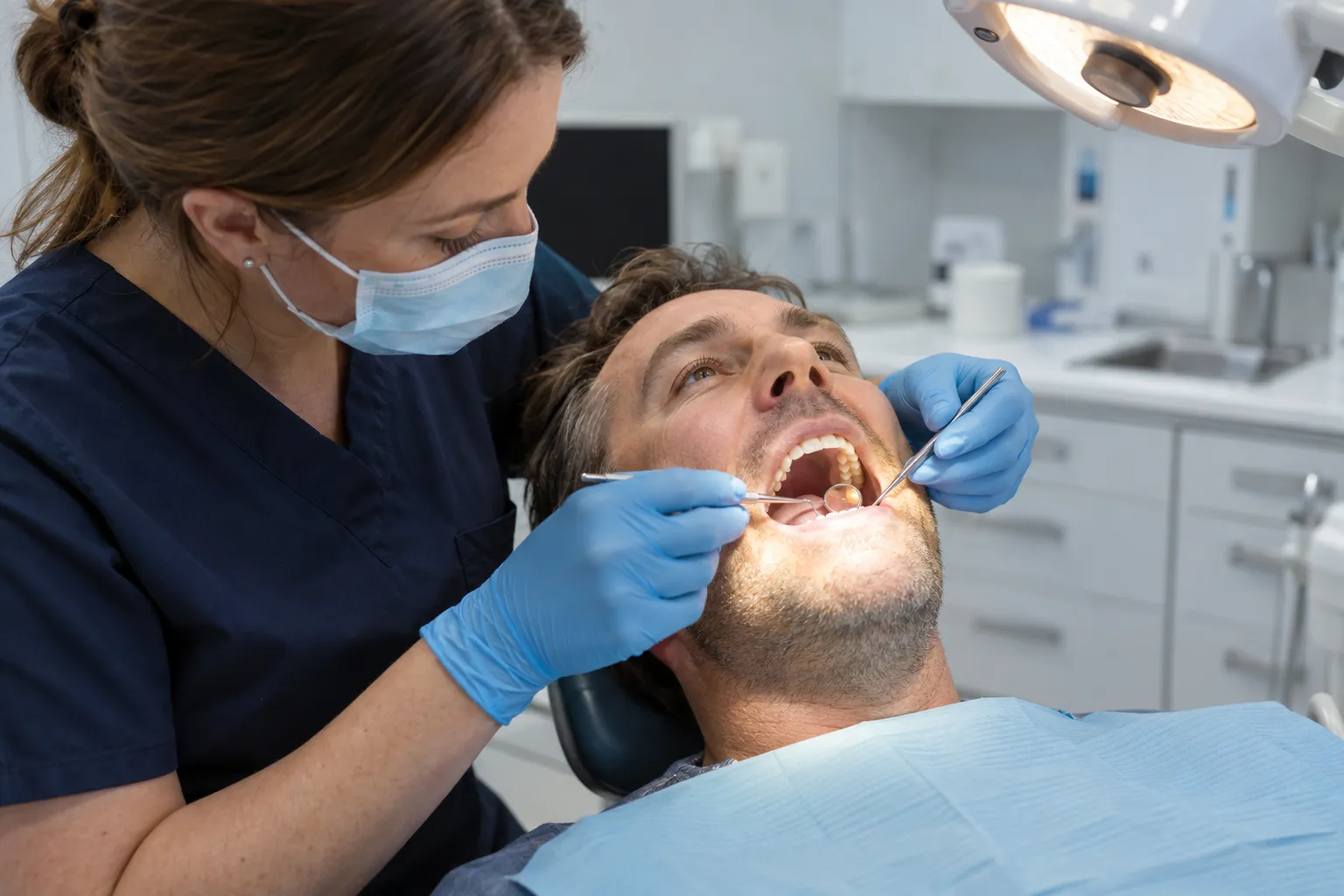
At a check-up, I look at every surface of every tooth and take X-rays where they're needed to see between teeth and under fillings. It's quick, and you can't do it from your bathroom, however good your phone torch is.
Is it a cavity or just a stain?
This is the big question for most people, and I'll be straight with you: from a photo or a mirror, often nobody can tell. Surface stains from things like tea, coffee and red wine can look dark. Decay can look dark. And there's a third option: old decay that has stopped in its tracks and hardened, which can also look brown or black.
Some clues point one way or the other, but they're clues, not answers:
- Stains tend to be flat, smooth and spread along several teeth.
- Decay is more likely if the spot feels rough or soft, catches food or floss, has a little dip in it, or the tooth has started to twinge with sweet, hot or cold things.
I go through this properly in black spot on a tooth: decay or stain? The short version is that your eyes and your tongue can raise the question, but it takes an examination, and sometimes an X-ray, to answer it.
When should you get a possible cavity checked?
If you've spotted a white patch, a dark spot or a hole, book a check-up rather than waiting for it to hurt. Small decay usually means small treatment. If it's already a cavity, a filling is the usual fix, and I explain what that feels like in do fillings hurt? and what it costs on the NHS in how much is a filling on the NHS? My guide to tooth fillings covers the rest.
Call us today, and say it's urgent, if:
- the tooth has started to ache, throb or keep you awake
- it gives a sharp pain with sweet, hot or cold things that lingers (see when tooth sensitivity is something more)
- a piece of the tooth has broken off
- your gum is swollen near the tooth, or there's a bad taste or pus
Call 999 or go to A&E, not a dentist, if:
- you're finding it hard to breathe, swallow or speak
- swelling is spreading towards your eye or down into your neck
- your eye is swollen or painful, or your eyesight suddenly changes
- you can't open your mouth properly because of swelling
In the meantime, the NHS advice is to brush twice a day with fluoride toothpaste, spit rather than rinse afterwards, and not have too much sugary food or drink.
If you're near Harlow or Enfield, I'd much rather take a look at that spot properly than have you squinting at it in the mirror for another month. Ring your nearest Minti practice and book a check-up. If it has started to hurt or swell, say it's urgent and we'll do our best to see you the same day. Anywhere else, or out of hours, call NHS 111.
This article is general information, not a diagnosis. A possible cavity needs examining in person to find out what it is.