On this page
You've been told you need a crown, and then someone asked whether you'd like porcelain or zirconia, as if you'd know. So now you're reading forums at midnight where people argue about crown materials with the passion normally reserved for football. You're not alone. "Which one should I have?" is one of the most common things I hear in my surgery once a crown is on the table.
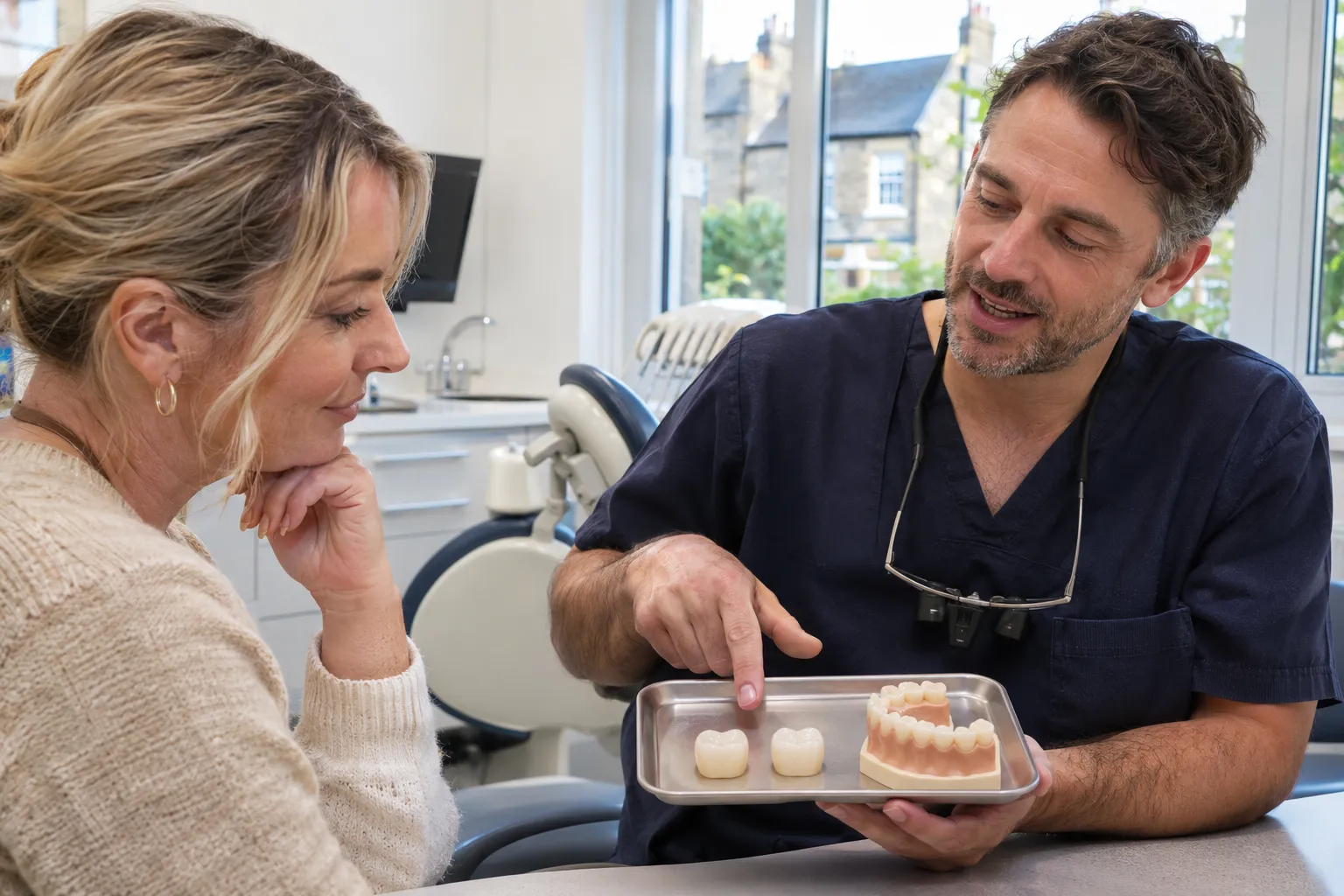
The short answer: both are tooth-coloured, metal-free crowns, and both can work very well. Porcelain-type ceramics, especially lithium disilicate (often sold as Emax), tend to win on looks and are a popular choice for front teeth. Zirconia is stronger, which makes it a good fit for back teeth and for people who grind. The right choice depends on which tooth it is, how much tooth is left, your bite and how it needs to look, so it's a decision to make in the chair, not from a comparison chart. To find out what suits your tooth, book a dental check-up and see how our dental crowns work. My full guide to dental crowns covers every type. If you're in pain, swollen or a crown has come off or broken, that's different: call my emergency dentist team in Harlow or Enfield, or NHS 111 if we're closed.
Trying to choose a crown material? Call your nearest Minti practice to book, and I'll talk you through the options for your tooth. If it's painful, swollen, or a crown has come off, tell reception it's urgent. I keep same-day appointments for pain and swelling wherever I can.
- Nuffield Dental Practice, Harlow: 01279 424 038
- Church Langley Dental, Harlow: 01279 306 690
- Enfield Smiles, Enfield: 020 8804 4320
Evening, weekend, or nowhere near us? Call NHS 111. If swelling is spreading to your eye or neck, or you're struggling to breathe or swallow, that's 999 or A&E.
What's the difference between porcelain and zirconia crowns?
First, a bit of untangling, because "porcelain" gets used loosely. The Oral Health Foundation lists the main crown types as porcelain bonded to metal, all-porcelain, all-ceramic and gold. When people say "porcelain vs zirconia", they usually mean two kinds of all-ceramic crown with no metal inside:
- Glass-ceramic ("porcelain") crowns: traditional porcelain and the stronger modern versions, such as lithium disilicate (Emax). They're known for looking very natural.
- Zirconia crowns: made from zirconium oxide, a very tough ceramic. They can be made as one solid piece (monolithic), or as a zirconia base with porcelain layered on top for looks.
Think of it as the difference between a wine glass and a mug. Both hold your tea. One looks lovelier on the table, the other survives being dropped in the sink.
If you're also wondering about metal options, gold or metal crowns covers those.
Which looks more natural?
Traditionally, glass-ceramic crowns have had the edge. With no metal underneath, light passes through the crown the way it does through a natural tooth, which is why they're a favourite for front teeth. Older zirconia was more opaque, a bit like a tooth that had been given a coat of emulsion.
That gap has narrowed. A 2017 laboratory study in the journal General Dentistry found that high-translucency zirconia, at the recommended thickness, was as translucent as lithium disilicate. That was a lab test on material samples, not a study of people's mouths, so I treat it as encouraging rather than the final word.
In practice, how natural a crown looks depends as much on the shade match, the shape and the skill of the technician as on the material itself.
Which is stronger and lasts longer?
Zirconia is the stronger material. The same 2017 study found high-translucency zirconia was far stronger than lithium disilicate when tested in the lab.
How long they last in real mouths is a slightly different question, and the evidence is less tidy. A large systematic review published in 2015 pooled studies of single crowns and found that most lithium disilicate and similar glass-ceramic crowns, and most zirconia-based crowns, were still in place after five years, with the zirconia-based crowns a little behind. Traditional feldspathic porcelain did less well. The zirconia crowns in those studies mostly had porcelain layered on top, and the main problems were that layer chipping and crowns coming loose. Solid monolithic zirconia doesn't have that layer, which is one reason it's become so popular for back teeth, but the long-term studies are still catching up.
What I'd say to anyone: the material matters, but the tooth underneath and how you look after it matter just as much. There's more on that in how long do dental crowns last.
Which is better for front teeth and back teeth?
This is the question that usually settles it. As a rule of thumb:
- Front teeth: looks come first, and bite forces are lower. A glass-ceramic crown such as lithium disilicate is often my starting point, though high-translucency zirconia can work too.
- Back teeth: strength comes first, because molars do the heavy chewing. Zirconia is a strong candidate, especially if you've broken crowns or fillings before.
- If you grind or clench: stronger materials make sense. The 2017 study specifically mentions a history of fractured restorations or grinding as situations where a strong material may be the better choice.
How much tooth is left matters too. Different materials need different thicknesses, so the amount of tooth I need to shape can affect what's possible. Sometimes the answer isn't a crown at all: if the tooth is still mostly there, crown vs veneer and dental bonding vs crown for a broken tooth are worth a read.
Do they cost different amounts?
Usually, yes, but I won't pretend there's a standard price. On the NHS, a crown is a Band 3 treatment (£332.10, checked on nhs.uk on 30 October 2026), and the NHS says you may be offered a metal-coloured crown on a back tooth. Private fees vary by practice and material, and should always be confirmed in writing before treatment. How much is a dental crown in the UK and how much is a crown on the NHS go into the detail, and our fees and finance page explains how payment works at Minti.
When should I book, and when is it urgent?
If you're planning a crown and the tooth isn't hurting, book an ordinary appointment. I'll examine the tooth, check your bite, take an X-ray if needed, and talk you through which material makes sense and what it costs before anything happens.
Call today, and say it's urgent, if:
- the tooth is painful, keeping you awake, or painkillers aren't helping
- your gum or face is swelling
- a crown has come off, chipped, broken or feels loose (see lost crown and my crown feels loose)
- a new crown hurts when you bite or is very sensitive (see why does my crown still hurt when I chew? and new crown sensitive to hot or cold)
Call 999 or go to A&E, not a dentist, if:
- you're finding it hard to breathe, swallow or speak
- swelling is spreading towards your eye or down into your neck
- your eye is swollen or painful, or your eyesight suddenly changes
- you can't open your mouth properly because of swelling
If you're near Harlow or Enfield, I'd much rather look at your tooth and your bite and help you choose than have you settling it by forum vote. Ring your nearest Minti practice to book. If it's painful, swollen or the crown has come off, say it's urgent and we'll do our best to see you the same day. Anywhere else, or out of hours, call NHS 111.
This article is general information, not a diagnosis or a quote. The right crown for your tooth can only be decided after an examination.