Your crown has come off, you've peered into the mirror, and the tooth underneath is dark. Grey, brown, maybe properly black. You've probably taken a photo, zoomed in, and then wished you hadn't. You're not imagining it, and you're not the only one. A dark stump under a crown is one of the most common things I hear about in my surgery, and it doesn't always mean what you're afraid it means.
The short answer: a tooth that looks black under a crown can be decay, but it's often something less dramatic: a metal filling or core, a root-filled tooth that has darkened over the years, or staining. You can't tell which from the mirror, and nor can I from a photo. It needs a look, a gentle feel and usually an X-ray. If it doesn't hurt, keep the crown safe and book in within the next few days. If it hurts, there's swelling, a sharp edge is cutting your tongue, or you think you've swallowed or breathed in a piece, call my emergency dentist team in Harlow or Enfield today, or NHS 111 if we're closed or you're not local. For what to do in the first hour, and for the bigger picture, see my lost crown guide.
Keep the crown in a clean, dry pot and bring it with you. Call your nearest Minti practice and tell reception what's happened. I keep same-day appointments for pain and swelling wherever I can.
- Nuffield Dental Practice, Harlow: 01279 424 038
- Church Langley Dental, Harlow: 01279 306 690
- Enfield Smiles, Enfield: 020 8804 4320
Evening, weekend, or nowhere near us? Call NHS 111. If you're struggling to breathe or swallow, you're coughing or wheezy after the crown came loose, or swelling is spreading to your eye or neck, that's 999 or A&E.
Why is the tooth under my crown black?
Here's the thing: the tooth under a crown was never meant to be seen again. Nobody was aiming for a nice colour when it was prepared. It's like lifting the carpet in an old house: what you find is usually functional and rarely pretty.
The usual suspects are:
- A metal filling or core. Before a crown goes on, a damaged tooth is often built up with filling material. If that was silver amalgam, it's dark grey to begin with, and it can stain the tooth around it over the years.
- A root-filled tooth. Teeth that have had root canal treatment can darken from the inside over time. That colour change is well known and isn't a sign of decay on its own.
- A metal post. If the tooth has a post in the root, you may see a dark metal circle in the middle of the stump.
- Decay. This is the one people worry about. The NHS describes decay as white, brown or black spots on a tooth, and under a crown it tends to start at the edge where the crown meets the tooth.
The inside of some crowns is metal, too. That tells you about the crown, not the tooth.
Is a black tooth under a crown always decay?
No, and I'd never assume it is. A metal core and a patch of decay can look annoyingly similar in a bathroom mirror, especially under a phone torch that makes everything look like a crime scene.
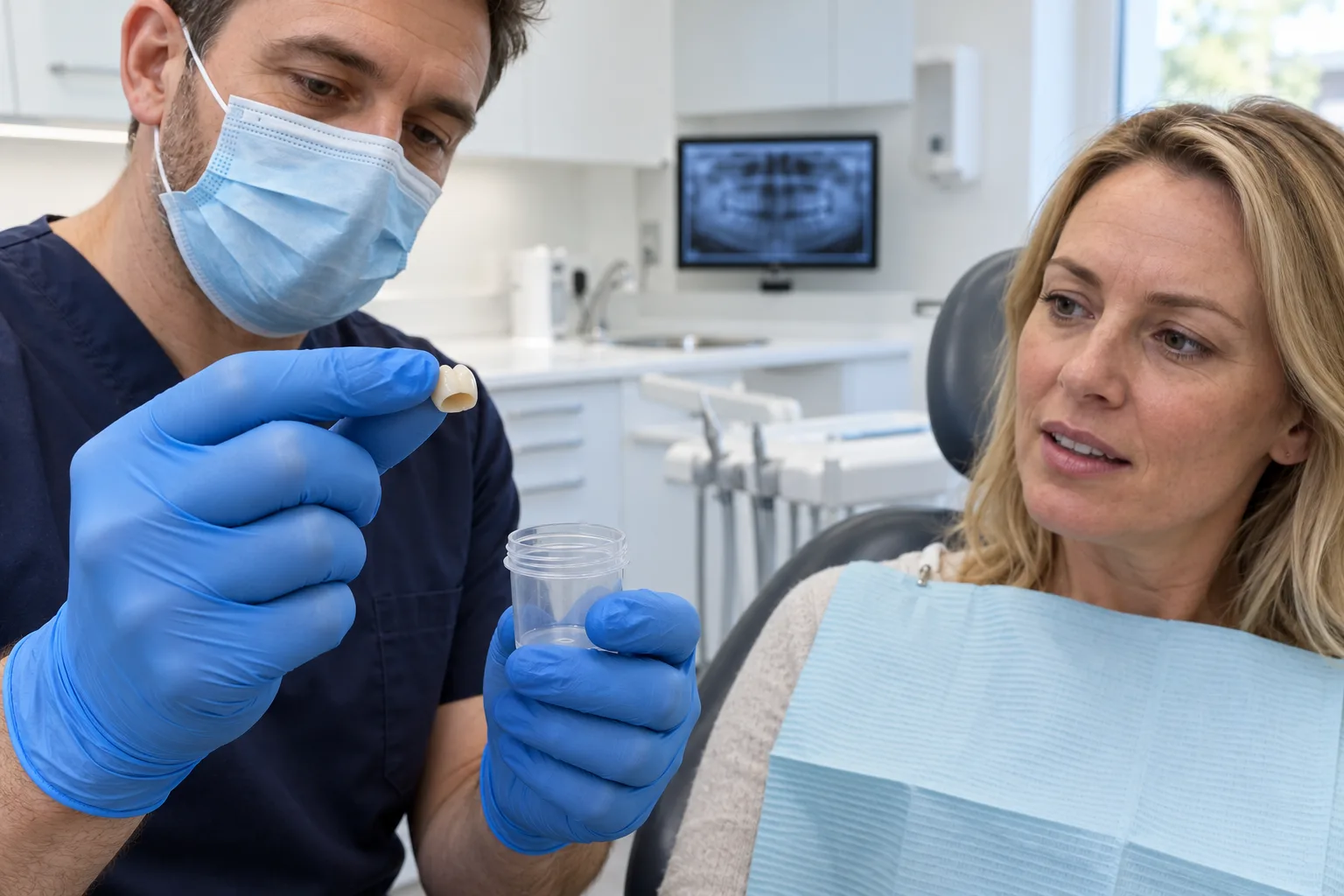
What I look for in the chair is a mix of colour, texture and position. Old metal fillings are hard and smooth. Staining in a root-filled tooth is also hard. Decay tends to be softer, can look brown or black and a little crumbly, and often sits right at the margin where the crown's edge used to be. An X-ray shows me what's happening deeper in, where your eyes and mine can't reach.
If you've been prodding it with your tongue to test for softness, leave that to me. Your tongue is enthusiastic but not very precise.
If it does turn out to be decay, it's worth knowing why the crown may have come off in the first place. Decay at the edge weakens the tooth the crown is gripping, until it simply lets go. I've written more about that in decay under a crown.
Does a black tooth mean the tooth is dead?
Not necessarily. Plenty of crowned teeth are perfectly alive. A tooth can also look dark because it already had root canal treatment years ago, which means the nerve was removed then, and that isn't a new problem.
Decay doesn't always hurt at first, though. The NHS says it may not cause any symptoms early on, and a root-filled tooth has no nerve inside to warn you, so no pain isn't the all-clear. That's the advice I give in the chair: a painless dark tooth is a reason to book, not a reason to relax. If decay is left, it can get deeper and eventually lead to infection.
Can my crown go back on if the tooth is black?
It depends on why it's black, not on the colour itself.
- Metal core or old staining, tooth sound: the crown can often be cleaned and re-cemented, as long as it still fits.
- Some decay: the decay needs removing first. The tooth may then need building back up and, often, a new crown, because the old one was made for the tooth as it was.
- Decay that has reached the nerve: root canal treatment may be needed before a new crown.
- Too much tooth lost: if there isn't enough left to hold a crown, we'd talk through the other options. There's more on that in crown fell out and there's no tooth left.
One thing I say to everyone: please don't stick the crown back on yourself, and definitely not with superglue. If there's decay under there, sealing it in just hides the problem. If a sharp edge is bothering you for a day or two, a pharmacy temporary repair kit can help; I've covered what it can and can't do in temporary cement from the pharmacy.
When should I see a dentist about a black tooth under a crown?
If it doesn't hurt, it's not an emergency, but don't park it for months. My rule is within a few days. An uncovered tooth is more exposed, and if there is decay, it won't sit still while you wait. There's more on timing in crown fell out but it doesn't hurt.
Until then, the NHS advice is to keep brushing twice a day with fluoride toothpaste, including gently around the exposed tooth, cut down on sugary food and drinks, avoid biting hard foods on that side, and skip very hot or cold food and drinks if it's sensitive.
Call us today if:
- the tooth or gum hurts, or painkillers aren't keeping on top of it
- there's swelling of the gum or face, a bad taste, or a temperature
- a sharp edge is cutting your tongue or cheek
- you think you swallowed the crown or part of it and feel fine
Call 999 or go to A&E, not a dentist, if:
- you're finding it hard to breathe, swallow or speak
- you think you've breathed in the crown or a piece of tooth, especially if you're coughing, wheezy or short of breath
- swelling is spreading towards your eye or down into your neck
- you can't open your mouth properly because of swelling
If you're near Harlow or Enfield, I'd much rather take a look than have you zooming in on photos of that tooth for another week. Ring your nearest Minti practice, bring the crown, and tell us what you've seen. If it hurts or there's swelling, say it's urgent and we'll do our best to see you the same day. Anywhere else, or out of hours, call NHS 111.
This article is general information, not a diagnosis. A tooth that has lost its crown needs examining in person to find the cause of any darkening.