You've been offered a metal crown, or you've spotted a gold one glinting at the back of a relative's mouth at a family do, and now you're wondering whether they're a clever choice or a relic from the days of shoulder pads. You've probably also wondered whether anyone would notice. You're not alone, and the answer is more interesting than you'd think.
The short answer: yes, for the right tooth. Gold and other metal crowns are very durable, can be made thin, so less of your tooth needs shaping, and gold wears at a similar rate to natural enamel, so it's kind to the teeth it bites against. The trade-off is looks, which is why they're mostly used on back teeth. On the NHS you may be offered a metal-coloured crown on a back tooth. Whether metal is right for you depends on the tooth, your bite and how much it matters to you that it's hidden. To find out, book a dental check-up and see how our dental crowns work. My full guide to dental crowns covers every type. If you're in pain, swollen or a crown has come off or broken, that's different: call my emergency dentist team in Harlow or Enfield, or NHS 111 if we're closed.
Weighing up a gold or metal crown? Call your nearest Minti practice to book, and I'll talk you through the options for your tooth. If it's painful, swollen, or a crown has come off, tell reception it's urgent. I keep same-day appointments for pain and swelling wherever I can.
- Nuffield Dental Practice, Harlow: 01279 424 038
- Church Langley Dental, Harlow: 01279 306 690
- Enfield Smiles, Enfield: 020 8804 4320
Evening, weekend, or nowhere near us? Call NHS 111. If swelling is spreading to your eye or neck, or you're struggling to breathe or swallow, that's 999 or A&E.
What are gold and metal crowns?
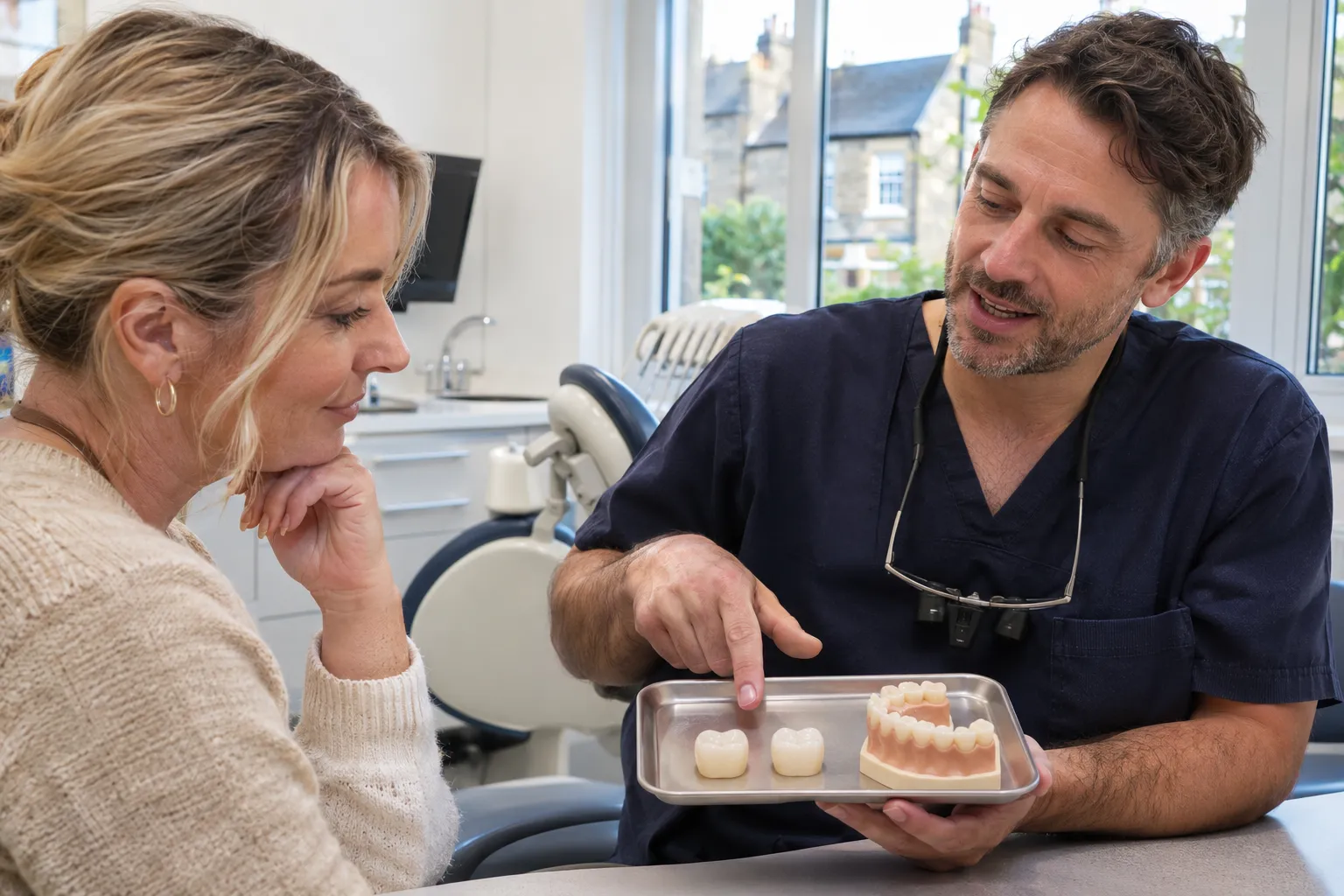
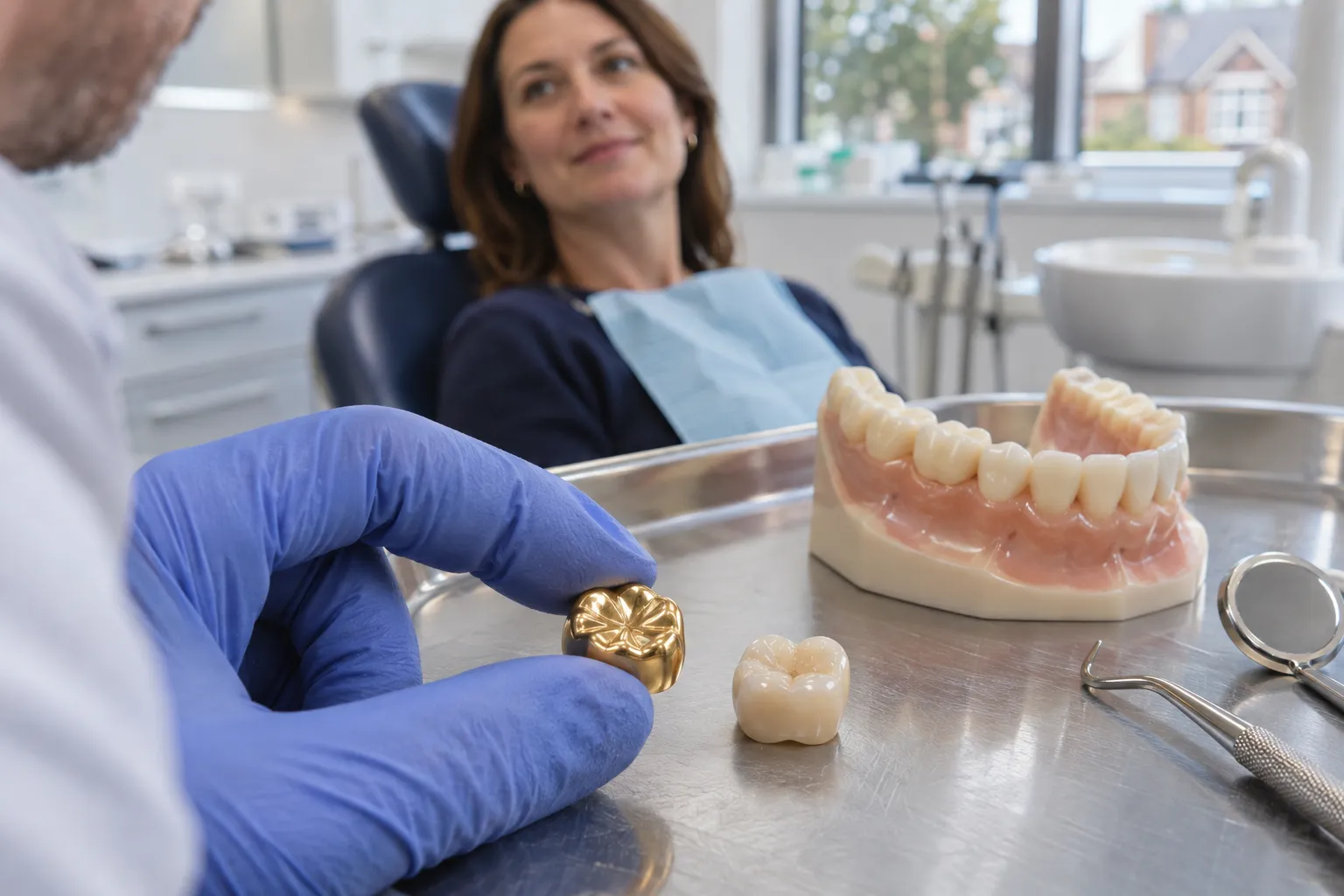
A crown is a custom-made cover that fits over a tooth to restore its shape, strength and appearance. Metal crowns come in a few flavours:
- Gold crowns: made from a gold alloy (gold mixed with other metals), so they're not solid 24-carat. They're the classic yellow crown.
- Other metal crowns: made from non-precious (base) metal alloys, which are silver-grey.
- Porcelain bonded to metal: a metal inner layer with tooth-coloured porcelain on the outside. The Oral Health Foundation describes these as common and natural-looking.
The Oral Health Foundation describes gold as very durable and typically used on back teeth.
What are the advantages of a gold crown?
Gold has a few things going for it that newer materials still find hard to beat:
- It's tough in thin layers. Gold is durable even when made thin, so less tooth needs to be removed to make room for it. That matters when a tooth is short or there's not much space above it.
- It's kind to the opposite tooth. Gold wears at a similar rate to natural enamel, so it's not likely to grind down the tooth it bites against.
- It doesn't chip. There's no porcelain layer on a full gold crown, so there's nothing to flake off.
Think of it as the Volvo estate of crowns. Nobody buys it to turn heads. They buy it because it'll still be going when everything else has been to the scrapyard. That's the reputation, anyway: I'll be straight with you, there's less modern research on gold crowns specifically than on the newer ceramics.
Dental Crowns at Minti
Private crowns start from £640 in Harlow and from £600 at Enfield Smiles. On the NHS, a crown falls under Band 3, £332.10.
Ask about crowns
What are the downsides of metal crowns?
- Looks. The big one. Metal shows, so metal crowns are generally used on back teeth rather than anywhere in your smile.
- Cost of gold. Precious metals such as gold carry their own cost. Which? lists precious metals among the private crown options.
- Base metals are harder. Non-precious alloys are stronger and harder than gold and can be made even thinner, but they're harder to adjust and more likely to wear the opposing tooth.
- Allergies. Some base metal alloys contain nickel, which can be a problem for people with a nickel allergy.
What about porcelain bonded to metal?
This is the middle ground and still very widely used. The metal gives strength, the porcelain gives a tooth-coloured outside. Which? describes NHS crowns as typically having a metal core with a porcelain wrapping, and the NHS says you may be offered a metal-coloured crown on a back tooth.
The track record is good. A large 2015 systematic review found about 95 in 100 metal-ceramic crowns were still in place after five years, a similar result to most all-ceramic crowns. The main thing people don't love is that they're not quite as lifelike as an all-ceramic crown, which matters more at the front. If you're comparing the metal-free options, see porcelain vs zirconia crowns.
Written Quotes Before You Decide
Your practice explains your options and sets out the cost in writing before treatment starts. Every quote is held for 30 days.
Request an appointment
So are gold or metal crowns still worth it?
In my view, yes, in the right situations. I'd put a metal or gold crown on the shortlist if:
- it's a back tooth that doesn't show when you smile
- there isn't much room above the tooth, or not much tooth left to shape
- you grind or clench, and you'd rather protect the opposite tooth
- you care more about durability than looks for that tooth
If the tooth is in your smile line, or you'd simply rather not see metal, a ceramic crown is usually the better fit. And if cost is part of the decision, the NHS Band 3 charge is £332.10 (checked on nhs.uk on 27 November 2026); private fees vary by material and practice and should be confirmed in writing before treatment. How much is a dental crown in the UK, how much is a crown on the NHS and our fees and finance page go into more detail.
However long any crown lasts, it depends a lot on the tooth underneath and how you look after it: see how long do dental crowns last.
When should I book, and when is it urgent?
If you're weighing up a crown and the tooth isn't hurting, book an ordinary appointment. I'll examine it, check your bite, take an X-ray if needed, and go through the materials and costs before anything happens.
Call today, and say it's urgent, if:
- the tooth is painful, keeping you awake, or painkillers aren't helping
- your gum or face is swelling
- a crown has come off, broken or feels loose (see lost crown, my crown fell off and my crown feels loose)
- a crowned tooth hurts when you bite (see why does my crown still hurt when I chew?)
Call 999 or go to A&E, not a dentist, if:
- you're finding it hard to breathe, swallow or speak
- swelling is spreading towards your eye or down into your neck
- your eye is swollen or painful, or your eyesight suddenly changes
- you can't open your mouth properly because of swelling
If you're near Harlow or Enfield, I'd much rather look at the tooth and help you pick the right material than have you deciding by what glints at family dos. Ring your nearest Minti practice to book. If it's painful, swollen or the crown has come off, say it's urgent and we'll do our best to see you the same day. Anywhere else, or out of hours, call NHS 111.
This article is general information, not a diagnosis or a quote. The right crown for your tooth can only be decided after an examination.