
So you've got a gap. Maybe it's new and you're still poking your tongue into it every five minutes. Maybe it's been there for years and you've just been told it's time to do something about it. Either way, someone has mentioned a bridge, and now you've got questions: what is it, will it look fake, what will it cost, and how long before you're back in the chair? Filling a gap is one of the most common things I plan with people in my surgery, so let's go through it properly.
The short answer: a dental bridge is a fixed false tooth (or teeth) held in place by the teeth next to the gap. The main types are conventional bridges, which use crowns on the teeth either side; cantilever bridges, which use one supporting tooth; adhesive (Maryland) bridges, which are bonded to the back of a neighbouring tooth with very little drilling; and bridges supported by implants. On the NHS in England, bridges are Band 3, currently £332.10 (checked on the NHS charges page on 5 October 2026). An NHS hospital leaflet says around 80% of conventional bridges last ten years or longer. The best first step is a dental check-up, and our dental bridges page explains how we do them. If a bridge has come loose, broken or is painful, call my emergency dentist team in Harlow or Enfield, or NHS 111 if we're closed.
Got a gap, or a bridge that's giving you trouble? Call your nearest Minti practice. Ask for a check-up to talk through a bridge, or tell reception it's urgent if you're in pain, have swelling or your bridge has come out. I keep same-day appointments for pain and swelling wherever I can.
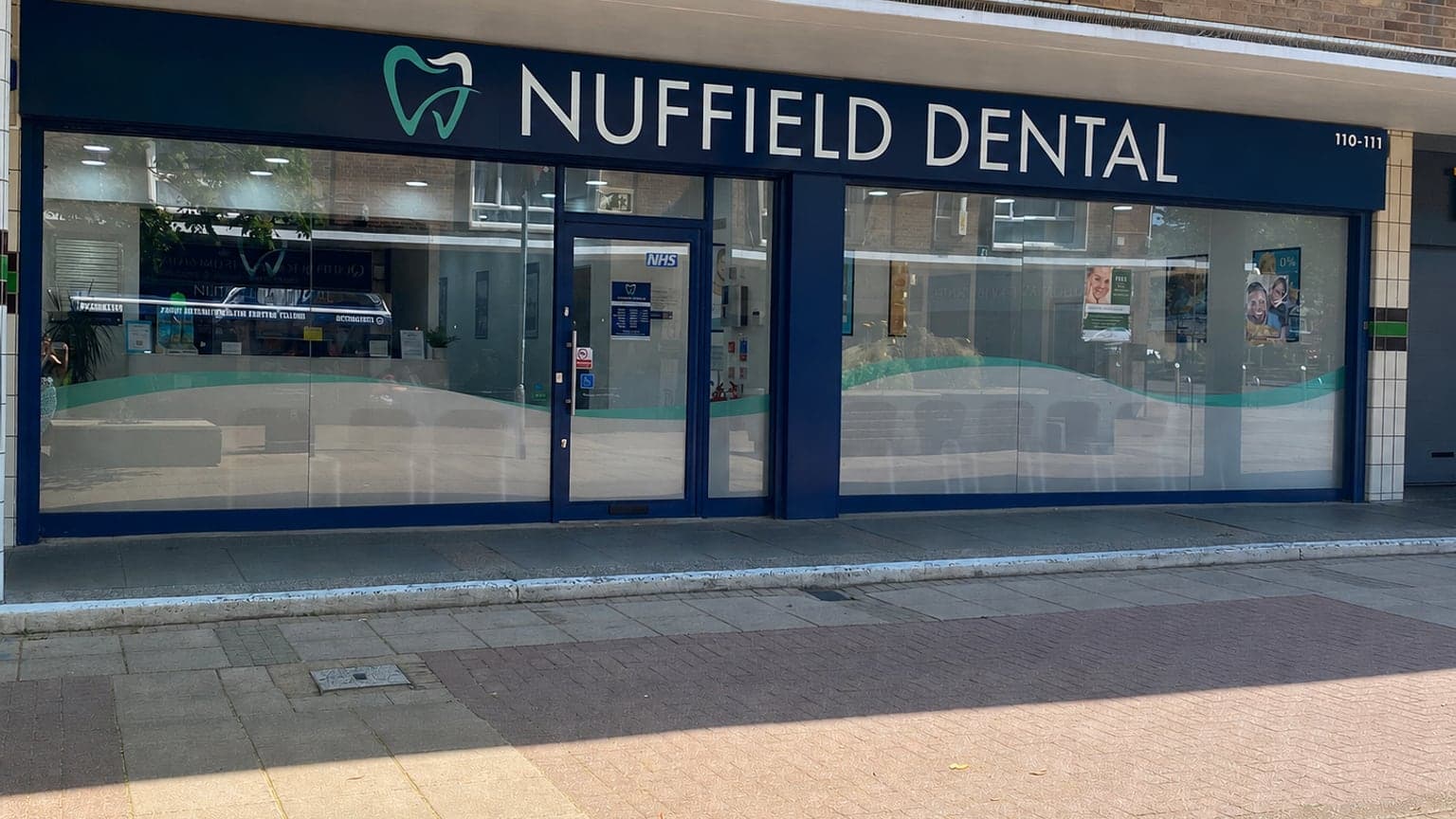
- Nuffield Dental Practice, Harlow: 01279 424 038
- Church Langley Dental, Harlow: 01279 306 690
- Enfield Smiles, Enfield: 020 8804 4320
Evening, weekend, or nowhere near us? Call NHS 111. If you're struggling to breathe or swallow, or swelling is spreading to your eye or neck, that's 999 or A&E.
What is a dental bridge?
The NHS describes a bridge as a fixed replacement for a missing tooth or teeth, usually made from metal and porcelain, that stays in your mouth, unlike a denture. The Oral Health Foundation puts it simply: it's fixed in place and you can't take it out.
The name tells you how it works. The false tooth in the middle (the pontic, if you want the jargon) spans the gap, and it's held up by the teeth either side, which are called abutments. It's a road bridge in miniature: the deck is the false tooth, the supports are your own teeth, and the whole thing is only as good as what it's standing on. That's why, when I plan a bridge, I spend more time looking at the teeth around the gap than at the gap itself.
Why fill a gap at all? Partly looks and chewing. Partly because the teeth either side can drift or tip into the space over time. The NHS lists bridges, dentures and implants as the main ways to fill one.
What types of dental bridge are there?
There are four main designs, and our bridges page lists all four.
- Conventional (fixed-fixed) bridge. The teeth either side are shaped and crowned, and the false tooth is joined between them. The Leeds Teaching Hospitals NHS leaflet describes this as the more secure option, but more destructive, because those teeth have to be drilled down.
- Cantilever bridge. The false tooth is held by one supporting tooth instead of two. A systematic review found cantilever bridges don't last quite as well as conventional ones, so they're used in particular situations.
- Adhesive (Maryland or resin-bonded) bridge. A small wing on the false tooth is bonded to the back of a neighbouring tooth. The Oral Health Foundation says it needs very little drilling and is often used for front teeth, where biting forces are lighter.
- Implant-supported bridge. Instead of leaning on natural teeth, the bridge sits on dental implants. Useful where several teeth are missing in a row.
For materials, the Oral Health Foundation lists porcelain bonded to metal, other strong metals under a porcelain coating, and all-porcelain options for a very natural look.
Maryland bridges
The gentlest option for the teeth next door, and my go-to for many single front teeth where the bite allows. The trade-off is that they can come unstuck.
Cantilever bridges
One support instead of two, which saves drilling a second tooth but puts more load on the one that's left.
How much does a dental bridge cost?
On the NHS in England, a bridge is a Band 3 treatment, which covers crowns, bridges and dentures. It's currently £332.10 for the whole course of treatment, checked on the NHS charges page on 5 October 2026. Some people pay less or nothing, depending on age, pregnancy, certain benefits or the NHS Low Income Scheme.
Privately, the fee depends on the type of bridge, how many teeth are involved and the materials used. I never quote figures in articles. You'll get a written plan and fee before anything starts, and our fees and finance page explains how that works.
Which bridge is right for a single tooth or a front tooth?
Most bridges replace one tooth, and the right design depends on where it is and what shape the neighbouring teeth are in. Here's my rule of thumb: if the teeth next to the gap are healthy and untouched, I'd much rather not drill them, so an adhesive bridge or an implant moves up my list. If they're already heavily filled or crowned, a conventional bridge can do two jobs at once.
Front tooth bridges
At the front, looks matter as much as strength: shade, shape and the gum line all have to match.
Is a bridge better than an implant or a denture?
Not always. It depends on your mouth. Our own implants page describes a bridge as faster, with no surgery, but involving preparation of the adjacent teeth. A dental implant leaves the neighbouring teeth alone but involves surgery, takes longer, and the NHS says it's usually only available privately.
Dental implants
At Minti, implant treatment is carried out at our Harlow practices, Nuffield and Church Langley; our dental implants page has the details.
A single tooth denture
A small removable denture carrying one tooth. It's quick, doesn't touch your other teeth, and is often used while a gap heals or as a longer-term option.
How long does a dental bridge last?
The NHS Leeds Teaching Hospitals leaflet says around 80% of conventional bridges last ten years or longer, and around 80% of adhesive bridges last five years or longer. A systematic review of cantilever bridges (Pjetursson and colleagues, 2004) found about 82% still in place at ten years. Many bridges last well beyond those figures, and some don't make it that far. How yours does depends mostly on the teeth and gums holding it up.
Think of it as a good roof. Built to last for years, but it helps if someone clears the gutters. Under a bridge, the gutter is the space beneath the false tooth, and the Oral Health Foundation says to clean under it every day with special floss or cleaning aids. A floss threader or interdental brush does the job, and regular check-ups let me spot early decay or gum problems before they threaten the bridge.
Is a bridge permanent?
Fixed, yes. For life, not usually, and the shaping of the supporting teeth can't be undone.
What problems can a bridge cause?
The bridge itself is tough. Problems nearly always start in the teeth and gums supporting it. The Leeds leaflet lists decay and gum disease around the supporting teeth, and says 10 to 15% of supporting teeth may eventually need root canal treatment because the nerve dies off.
A bridge that's loose or has fallen out
Keep it safe, don't glue it back yourself, and ring us.
Pain under a bridge
Usually decay under a supporting crown, gum problems, a high bite on a new bridge, or a struggling nerve.
Infection around a bridge
I'll keep this one straight. Throbbing, a swollen gum, pus or a bad taste around a bridge can mean infection, and that needs seeing the same day. Antibiotics are only an add-on if it's spreading or you're unwell with it; the cause still has to be treated.
What happens when you get a bridge?
For a conventional bridge, it's usually a few visits. First I examine the gap and the teeth around it and take X-rays. Then the supporting teeth are shaped, impressions or scans are taken, and you wear a temporary bridge while the lab makes the real one. Finally it's fitted, the bite is checked, and I show you how to clean under it. Our bridges page describes it as three appointments over about six weeks. An adhesive bridge usually needs much less preparation.
If the bite feels high once the numbness wears off, come back. It's a quick adjustment, and I'd far rather do it than have you put up with it.
When should I see a dentist about a bridge?
Book a routine check-up if you've got a gap you'd like to fill, you've been told a tooth needs to come out and want to plan ahead, or an existing bridge is looking tired or hard to clean under.
Call us today if:
- your bridge is loose, rocking or has come out
- a piece has chipped or broken off
- a tooth under or next to the bridge hurts, throbs or lingers after hot or cold
- the gum around the bridge is swollen, has a spot on it, or there's pus or a bad taste
- you have a high temperature with tooth or gum pain
Call 999 or go to A&E, not a dentist, if:
- you're finding it hard to breathe, swallow or speak
- swelling is spreading towards your eye or down into your neck
- you can't open your mouth properly because of swelling
If you're near Harlow or Enfield, I'd much rather take a look at the gap, or the bridge, and give you your options in plain English than have you poking your tongue into that space for another year. Ring your nearest Minti practice and ask for a check-up, or tell us it's urgent if something hurts. Anywhere else, or out of hours, call NHS 111.
This article is general information, not a diagnosis or a quote. A bridge needs planning in person.