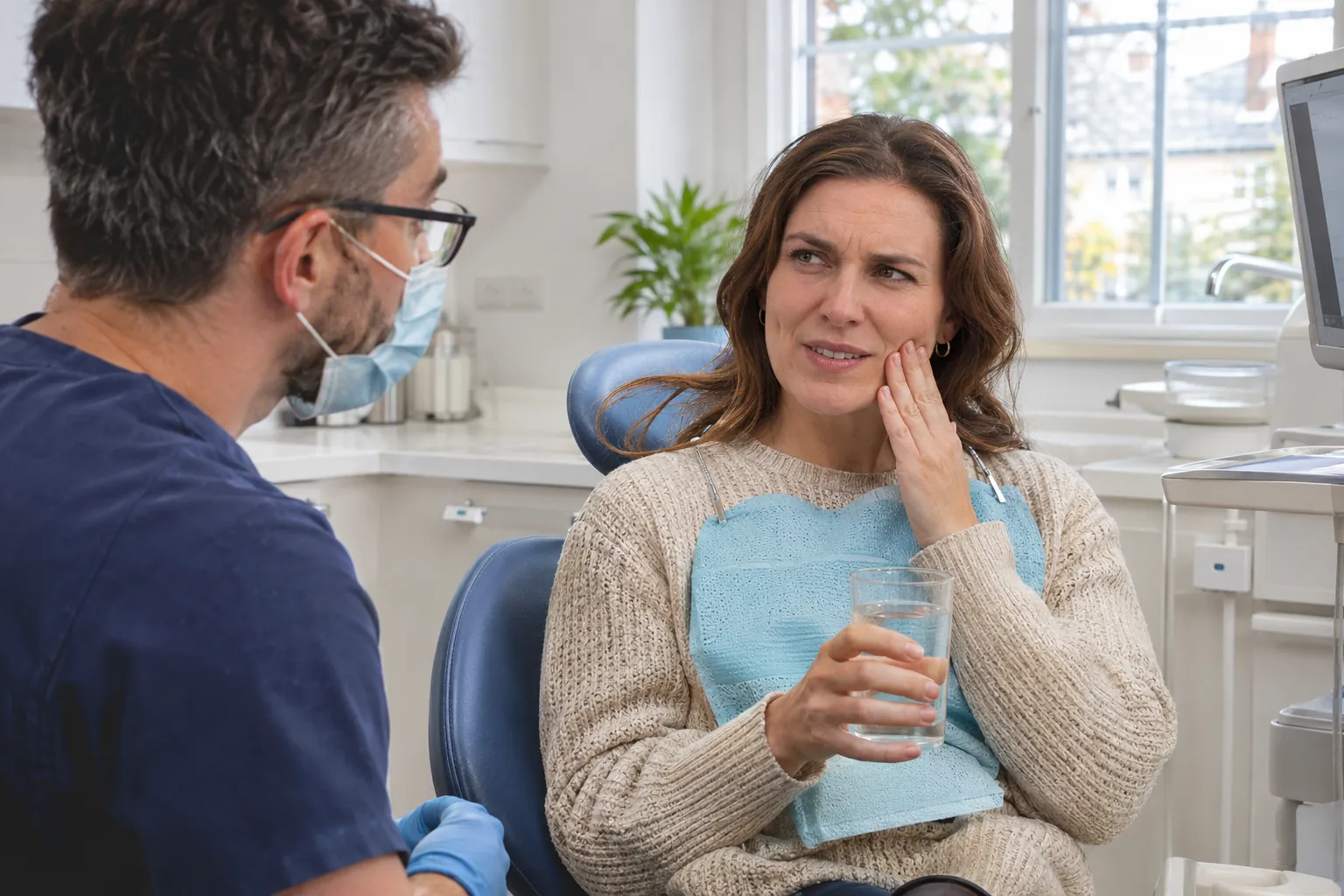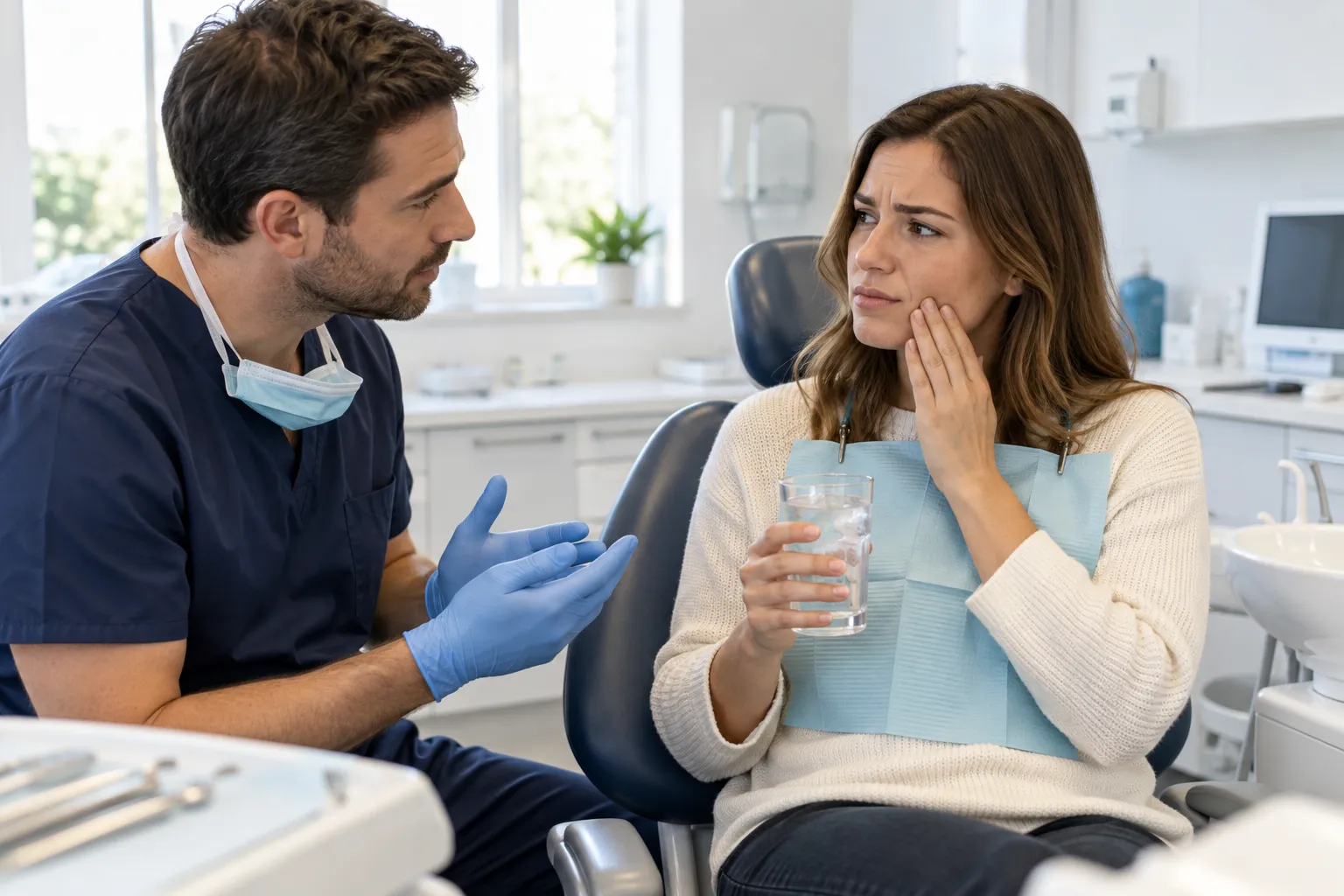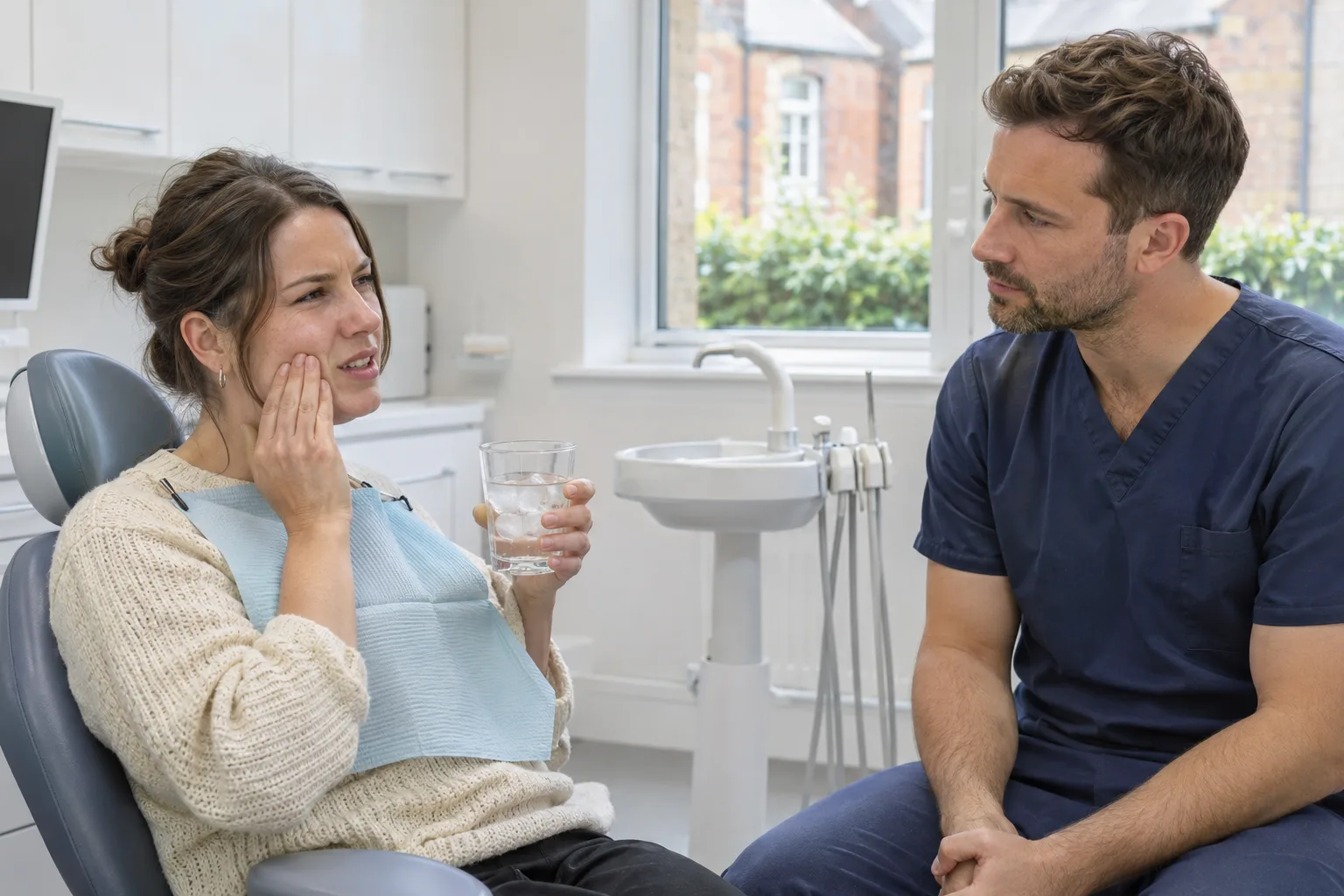
You've started drinking cold drinks out of the corner of your mouth, like a cowboy in a saloon. Ice cream now comes with a warm-up routine. And somewhere in the back of your mind is the question you actually typed in: is this just sensitivity, or have I got a hole? You're not imagining it, and you're not the only one. It's one of the most common questions I get asked in my surgery.
The short answer: a tooth that's sensitive to cold can be simple sensitivity from exposed dentine, or early decay, and the two can feel almost identical: a sharp twinge that fades within seconds of the cold going. The clues that tip it towards decay are one tooth rather than several, sweet things setting it off, a dark spot or hole, and toothpaste making no difference. Only an examination, and sometimes an X-ray, can tell them apart, so book a dental check-up. If the cold pain lingers or throbs after the cold has gone, wakes you up, or comes with swelling, call my emergency dentist team in Harlow or Enfield, or NHS 111 if we're closed or you're not local. More in my sensitive teeth guide.
Cold pain that lingers, throbs or keeps you awake? That's more than sensitivity. Call your nearest Minti practice and tell reception it's urgent. I keep same-day appointments for pain and swelling wherever I can.
- Nuffield Dental Practice, Harlow: 01279 424 038
- Church Langley Dental, Harlow: 01279 306 690
- Enfield Smiles, Enfield: 020 8804 4320
Evening, weekend, or nowhere near us? Call NHS 111. If you're struggling to breathe or swallow, or swelling is spreading to your eye or neck, that's 999 or A&E.
Why does cold make a tooth hurt?
Enamel, the outer shell, has no feeling at all. The layer under it, dentine, is a different story. It's full of microscopic fluid-filled tubes that run to the nerve, like a bundle of very tiny drinking straws, all pointing at the nerve.
Cold makes the fluid in those straws shift, and the nerve at the other end picks it up as a sharp jolt. So a cold twinge only tells me one thing for certain: something has opened a way through to the dentine. The question is what. Worn enamel or a receding gum is sensitivity. A cavity eating through the enamel is decay. Same straws, different hole.
If cold air is the thing that gets you, that has its own section in my guide: why does my tooth hurt when I breathe in cold air?
Check-Ups for Sensitive Teeth
A dentist can find what is causing the sensitivity. A private check-up is £35 to £38, and an NHS check-up is Band 1, £27.90.
Book a check-up
Does sensitivity feel different from decay?
Here's the annoying bit: often, no. Simple sensitivity gives a sharp, sudden, short-lived pain when something sets it off. Early decay that has reached the dentine does much the same, with pain that comes on with cold, heat or sweet things and stops once they've gone. So I wouldn't trust anyone, including me, to tell them apart from a description alone.
What does help is the overall pattern:
- Leans towards sensitivity: several teeth, usually near the gum line; cold and acidic things are the main triggers; it's been building gradually; sensitive toothpaste helps after a few weeks.
- Leans towards decay: one tooth; sweet things set it off as well as cold; it came on fairly recently; toothpaste makes no difference.
Leans, not proves. Plenty of people have a bit of both, and decay can happen right next to a sensitive root, since roots exposed by receding gums are more prone to decay themselves.
What are the signs that it's decay?
Things I'd want you to mention when you book:
- a brown, black or chalky white spot on the tooth
- a rough edge, a hole or a gap your tongue keeps finding
- food catching in the same place
- sweet things giving a twinge in that one tooth (see why do sweet things make my tooth hurt?)
- pain when you bite
And here's the thing about decay: early on it often causes no symptoms at all. So a tooth that has started reacting to cold is doing you a favour. It's raising its hand before the problem gets bigger.
It can also be neither. A crack, or an old filling that has lost its seal, can let cold in the same way. And if the tooth was filled or crowned recently, see sensitivity after a filling or a new crown.
New Patient Consultations
A new patient consultation is £45 at our Harlow practices and £35 at Enfield Smiles. Every practice offers NHS and private care.
Request an appointment
What if the cold pain lingers?
I'll keep this bit straight, because it's the one that changes things.
Sensitivity and early decay both give pain that's gone within a second or two of the cold going. If the ache hangs around for many seconds or minutes afterwards, turns into a dull throb, or starts up by itself, that suggests the nerve inside the tooth is inflamed. That can happen when decay gets deep. It can keep you awake, and toothpaste won't touch it.
If you've reached the stage where hot drinks hurt and cold water actually soothes it, that's another sign the nerve is struggling. See why hot drinks make a tooth hurt and cold water helps my toothache. Either way, call today.
How can I find out which it is, and when should I get it checked?
You can't settle this from the mirror, and neither can Google. An examination can. I'll look at the tooth closely, test it with cold and a puff of air to see how it reacts and how quickly it settles, check any fillings, and take an X-ray if I need to see between the teeth or under an old filling, where decay likes to hide.
If it's sensitivity, a toothpaste for sensitive teeth is the first step. Spit rather than rinse, and rub a little onto the spot at night; my guide to toothpaste for sensitive teeth covers what's in them. Beyond that, I can apply fluoride varnish or a protective coating. If it's decay, a filling deals with the cause.
Book an ordinary appointment soon if it's one tooth, it's new, sweet things set it off, you can see a mark or hole, or sensitive toothpaste hasn't helped after a few weeks. The NHS advises seeing a dentist if toothache lasts more than two days.
Call us today if:
- the pain lingers or throbs after the cold has gone
- it wakes you at night, or painkillers aren't helping
- it hurts to bite, or a piece of tooth or filling has broken off
- there's swelling of your gum or face, a bad taste, or a temperature
Call 999 or go to A&E, not a dentist, if:
- it's hard to breathe, swallow or speak
- swelling is spreading towards your eye or into your neck
- your eye is swollen or painful, or your eyesight suddenly changes
- you can't open your mouth properly because of swelling
If you're near Harlow or Enfield, I'd much rather take a look and give you a straight answer than have you drinking out of the side of your mouth all winter. Ring your nearest Minti practice and tell us which tooth and what sets it off. If it has turned into proper toothache, say it's urgent and we'll do our best to see you the same day. Anywhere else, or out of hours, call NHS 111.
This article is general information, not a diagnosis. Tooth pain needs examining in person to find the cause.