On this page
You brush, you spit, and there it is: a little swirl of pink in the sink. So you brush a bit more gently, spit again, and squint at it like it might change its mind. Maybe you've even started avoiding one corner of your mouth because it's the corner that bleeds. You're not imagining it, and you're definitely not the only one. It's one of the most common things I hear in my surgery.
The short answer: gums that bleed when you brush are nearly always inflamed, and the usual cause is plaque building up along the gum line. That's gingivitis, the earliest stage of gum disease, and the good news is it can be reversed. Keep brushing, gently and thoroughly, and clean between your teeth. Then book a dental check-up so I can see what's going on and get my hygiene team to clean away anything your toothbrush can't reach. If the bleeding is heavy, won't stop, or comes with swelling or a loose tooth, call my emergency dentist team in Harlow or Enfield, or NHS 111 if we're closed. The wider picture is in my gum disease guide.
Bleeding that won't stop, swelling, or a loose tooth? Call your nearest Minti practice and tell reception. I keep same-day appointments for pain and swelling wherever I can.
- Nuffield Dental Practice, Harlow: 01279 424 038
- Church Langley Dental, Harlow: 01279 306 690
- Enfield Smiles, Enfield: 020 8804 4320
Evening, weekend, or nowhere near us? Call NHS 111. If you're struggling to breathe or swallow, or swelling is spreading to your eye or neck, that's 999 or A&E.
Why do gums bleed when you brush?
Plaque is the soft, sticky film of bacteria that builds up on your teeth every day. When it sits along the gum line, your gums react to it. They get inflamed: redder, a bit puffy, and full of extra blood flow. Inflamed gum tissue is fragile, so the brush that would glide over a healthy gum makes an inflamed one bleed.
The NHS lists bleeding when you brush, floss or eat hard foods like apples as one of the first signs of gum disease. It isn't normal for healthy gums to bleed with ordinary brushing, so the pink in the sink is worth listening to.
If plaque is left long enough it hardens into tartar, which your toothbrush can't shift. Think of it like limescale on a kettle: a scrub won't touch it once it's set, and it needs a professional clean. That's where my hygiene team comes in.
Bleeding usually doesn't come with pain, which is why so many people put it off. For the full list of early signs, see gum disease symptoms, and for a visual check, what does gum disease look like?
Am I brushing too hard?
Possibly, but it's rarely the whole story. People who brush hard are nearly always the keenest brushers in the building, so if that's you, I'm not telling you off. Heavy, side-to-side scrubbing is more often linked with gums wearing back over time (more on that in receding gums) than with bleeding on its own.
The bleeding itself is usually the plaque. Here's a way to think about it: you can scrub a doorstep as hard as you like, but if you keep missing the corner by the frame, the corner stays grubby. Gum lines and the gaps between teeth are the corners. A brush on its own doesn't reach between teeth, which is why the NHS advice includes cleaning between them every day with floss or interdental brushes.
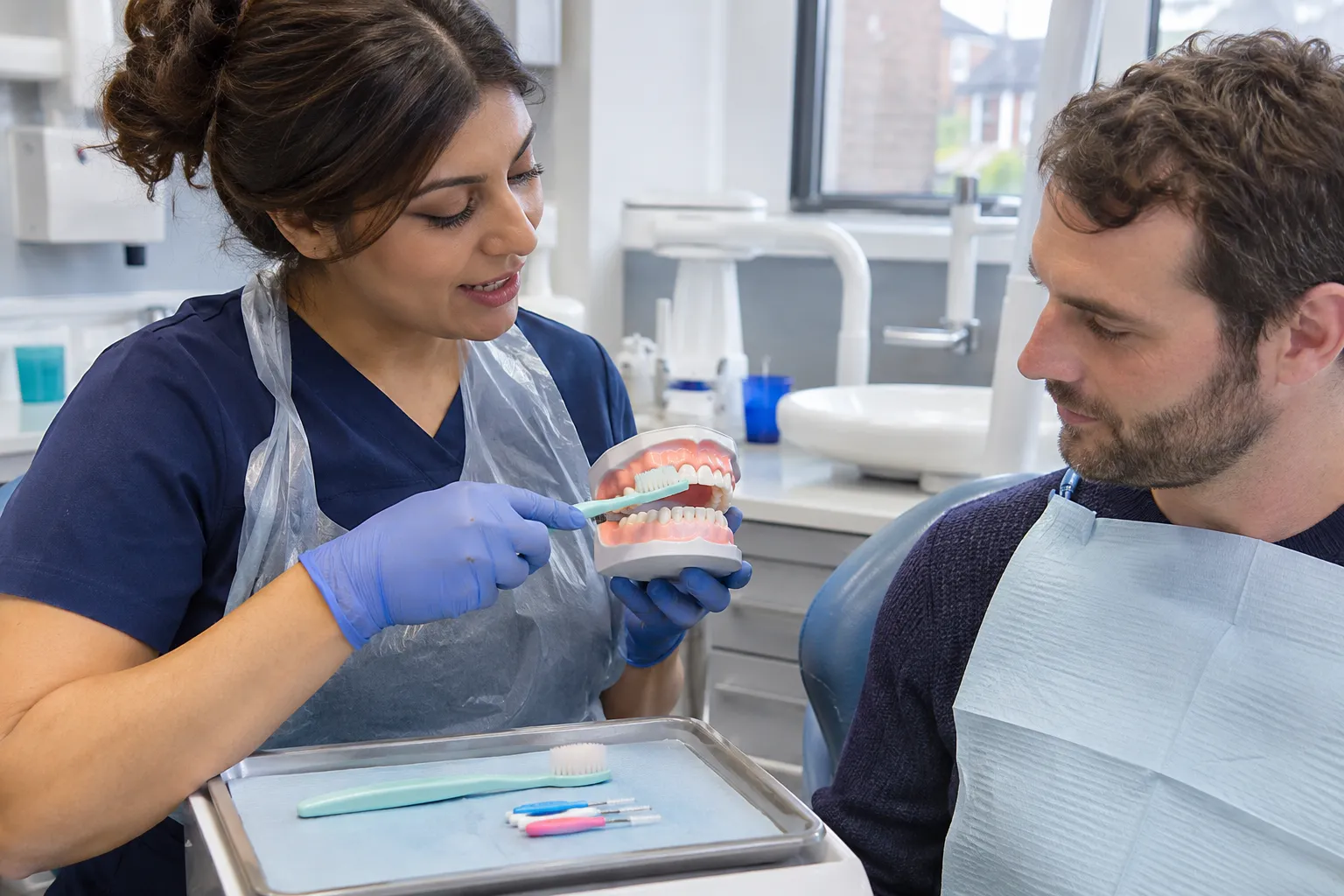
What I suggest in the chair is gentle, small movements angled at the gum line, rather than more force. If you use an electric toothbrush, let it do the work and guide it along. I'm happy to show you at your check-up, which is quicker than any video.
Should I stop brushing if my gums bleed?
No. This is the one I most want you to take away. It's tempting to leave the bleeding bit alone, but that lets more plaque build up there, which makes the gum more inflamed, which makes it bleed more. It's a loop, and backing off keeps you in it.
The NHS advice is to:
- brush at least twice a day with fluoride toothpaste
- clean between your teeth every day with floss or interdental brushes
- spit after brushing rather than rinsing, and don't use mouthwash straight after brushing
- not smoke
If you've just started cleaning between your teeth, some bleeding at first is common, because those are exactly the spots that have been missed. Keep going gently. The MSD Manual notes that gums have an excellent blood supply and tend to recover quickly once plaque and tartar are removed. If it isn't settling after a couple of weeks of good cleaning, that's my cue to take a look.
What else can make gums bleed?
Plaque is the usual culprit, but not the only one. The MSD Manual lists:
- Pregnancy and hormone changes, which can make gums react more strongly to plaque. The NHS notes that NHS dental care is free during pregnancy and for 12 months after.
- Diabetes. NICE advises that adults with diabetes are at higher risk of gum disease and should have regular dental checks.
- Some medicines, and blood-thinning medicines can make any bleeding last longer. Don't stop a prescribed medicine because of your gums; talk to your GP or me first.
- Less often, vitamin C deficiency or a blood condition such as leukaemia.
If it's one small spot rather than the whole mouth, it may be something local; see one small area of gum keeps bleeding.
I'll keep this bit straight. The NHS says bleeding or bruising easily or for no reason should be checked by a GP. If your gums bleed and you also have bruises you can't explain, nosebleeds, or you feel tired, weak or unwell, please see your GP promptly as well as your dentist.
When should I see a dentist about bleeding gums?
Book a check-up if:
- your gums bleed when you brush or floss, even if it's only a little
- it hasn't settled after a couple of weeks of gentle, thorough cleaning
- your gums look red or swollen, or you have bad breath
At the appointment I'll check your gums, gently measure the gap between gum and tooth, take X-rays if needed, and tell you plainly what stage you're at. Often the answer is a professional clean and a few tweaks to your routine.
Call us today if:
- your gums are bleeding heavily or the bleeding won't stop
- your gums are very sore and swollen
- a tooth has become loose
- you have swelling with a fever or feel unwell
See your GP promptly, or call NHS 111, if: your gums are bleeding and you're also bruising easily for no reason, or feeling unusually tired, weak or unwell.
Call 999 or go to A&E, not a dentist, if:
- it's hard to breathe, swallow or speak
- swelling is spreading towards your eye or into your neck
- your eye is swollen or painful, or your eyesight suddenly changes
- you can't open your mouth properly because of swelling
If you're near Harlow or Enfield and your gums keep bleeding when you brush, I'd much rather take a look than have you keep brushing around the sore bit and hoping. Caught at this stage, it's very often something we can turn around.
This article is general information, not a diagnosis. Gum problems need examining in person to find the cause.