You've just taken the least flattering photo of your life: lips stretched back, flash on, phone jammed at an angle no camera was designed for. Now you're zooming in on your own gums and comparing them with pictures online, and everything looks slightly alarming. You're not imagining it, and you're not the only one doing it. It's one of the most common things I get asked about in my surgery.
The short answer: healthy gums are pink, firm and fit snugly around each tooth. Gum disease makes them look red or darker than usual, puffy and sometimes shiny, especially along the edge next to the teeth, and they bleed easily when brushed. Later on, gums can shrink back so teeth look longer, and teeth can drift or feel loose. Photos only get you so far, so book a dental check-up and I'll tell you what's actually going on, with my hygiene team on hand if you need a clean. If your gums are very swollen and sore, or a tooth is loose, call my emergency dentist team in Harlow or Enfield, or NHS 111 if we're closed. For the bigger picture, see my gum disease guide.
Gums very swollen and sore, pus, or a loose tooth? Call your nearest Minti practice and tell reception. I keep same-day appointments for pain and swelling wherever I can.
- Nuffield Dental Practice, Harlow: 01279 424 038
- Church Langley Dental, Harlow: 01279 306 690
- Enfield Smiles, Enfield: 020 8804 4320
Evening, weekend, or nowhere near us? Call NHS 111. If you're struggling to breathe or swallow, or swelling is spreading to your eye or neck, that's 999 or A&E.
What do healthy gums look like?
You need the "before" picture before you can judge the "after". Healthy gums are:
- Pink and firm, not red and squashy. The MSD Manual also describes a slightly dimpled texture, a bit like orange peel.
- Snug to the tooth. The edge hugs each tooth neatly, and the little bits of gum between your teeth come to a point.
- Quiet when brushed. No bleeding with normal brushing.
One thing to know: "pink" covers a range. Plenty of people naturally have darker or brownish patches of pigment in their gums, and that's normal for them. What I'm looking for is change, and colour that's different from the rest of your own gums.
What does early gum disease (gingivitis) look like?
Gingivitis is the early, reversible stage. It tends to look like:
- Redness along the gum line, a darker band right where gum meets tooth.
- Puffiness. The pointed bits between the teeth go rounded and swollen, a bit like a tent that's been overinflated.
- A shiny, smooth look, because the swelling stretches out that orange-peel texture.
- Bleeding when you brush, floss or bite into something hard.
Here's the catch. Early gum disease usually doesn't hurt, and it can look pretty subtle, particularly on the back teeth you can't see without a mirror and a contortionist's neck. It can also sit under a layer of plaque or hard tartar, which looks like a creamy or yellowish crust near the gum line. Think of tartar as limescale for teeth: once it's set hard, your toothbrush can't shift it and it needs a professional clean.
If you're seeing the red, puffy, bleeding version, the good news is that this stage can be turned around. I explain why your gums bleed in why do my gums bleed when I brush? and the full list of early signs in gum disease symptoms.
What does advanced gum disease look like?
When gum disease moves down to the bone and tissue holding your teeth in, it's called periodontitis. The NHS and the MSD Manual describe changes such as:
- Gums shrinking back, so teeth look longer and you may see the darker root surface. More in receding gums.
- Teeth drifting, with new gaps appearing, or teeth that feel loose.
- A gum abscess: a painful, swollen lump on the gum, sometimes with pus.
- Bad breath or a bad taste that brushing doesn't fix.
Some of this can look surprisingly mild from the outside. The real damage is under the gum line, around the roots, where no phone camera reaches. That's why I measure it rather than guess. There's more on how the two stages differ in gingivitis vs periodontitis.
A few things look like gum disease but aren't. A single swollen spot or pimple on the gum is often something local, like an infected tooth; see pimple or boil on your gum. And I'll say this plainly: the NHS advises an urgent dental appointment for ulcers or red patches in your mouth, or a lump in your mouth or on your lip, alongside gum problems. Those need checking in person.
Can I check my own gums at home?
You can do a decent first look. Good light, a clean mirror, and:
- Compare the colour at the gum edge with the gum higher up.
- Look at the bits between your teeth: pointed or puffed up?
- Notice whether you see pink when you spit after brushing.
- Check whether any teeth look longer than they used to, or have moved.
What you can't do at home is see below the gum line or check the bone. If you smoke, your gums may also look healthier than they are, because smoking can hide redness and bleeding. So a clean-looking mirror check isn't a clean bill of health. A photo is a good reason to book, not a reason to skip booking.
When should I get my gums looked at?
Book a check-up if you've noticed any of these:
- red, puffy or shiny gums, or gums that look different from how they used to
- bleeding when you brush or floss
- gums that seem to have shrunk back, or teeth that look longer
- bad breath or a bad taste that won't shift
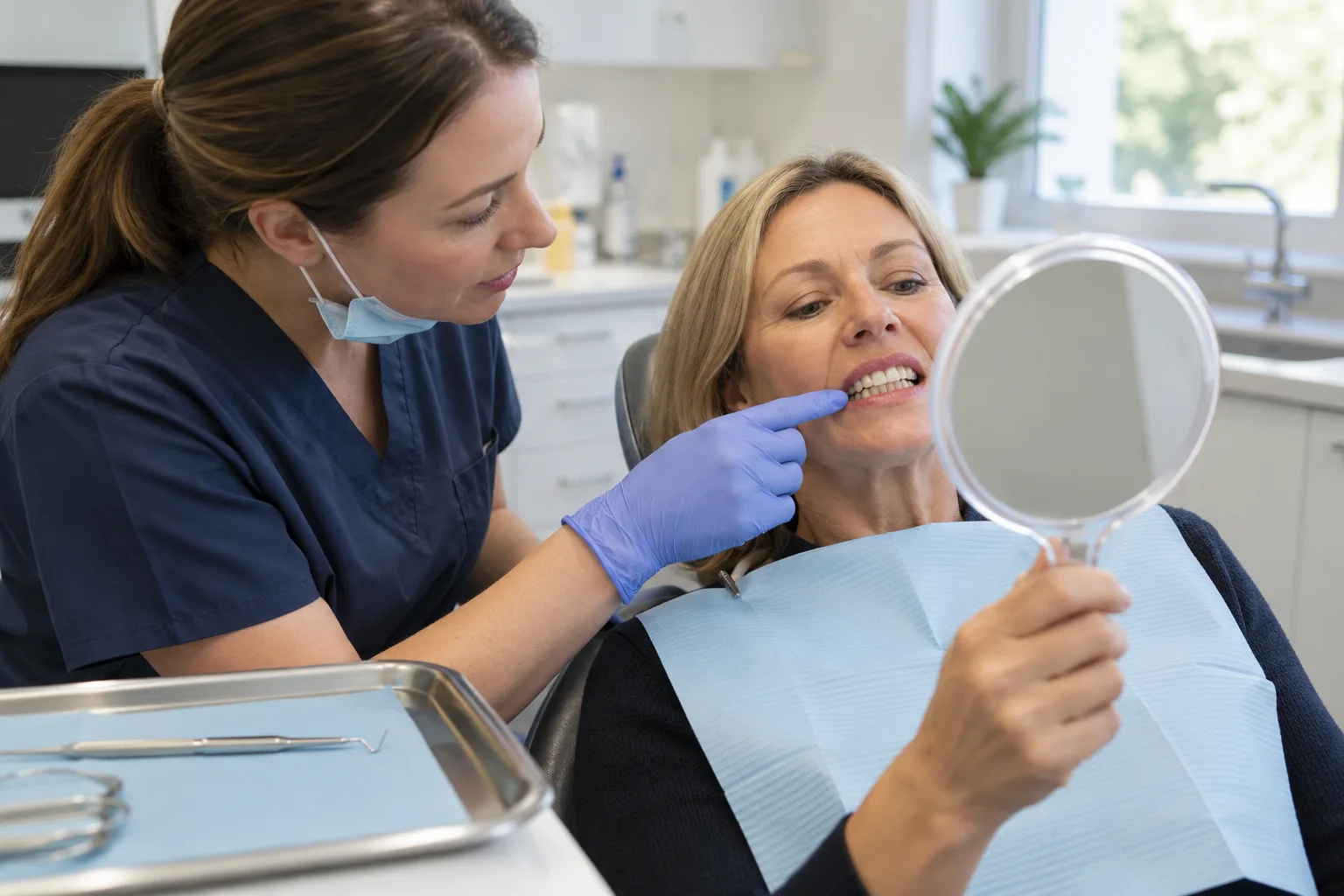
At the appointment I'll look, gently measure the gap between gum and tooth with a thin probe, and take X-rays if I need to see the bone. Then I'll tell you what stage you're at and what happens next.
Call us today if:
- your gums are very swollen and sore
- a tooth has become loose
- there's a painful lump, pus or a bad taste from one spot
- your gums are bleeding heavily or won't stop
- you have swelling with a fever or feel unwell
See your GP promptly, or call NHS 111, if: your gums are bleeding and you're also bruising easily for no reason, or feeling unusually tired, weak or unwell. The NHS says easy or unexplained bleeding or bruising should be checked by a GP.
Call 999 or go to A&E, not a dentist, if:
- it's hard to breathe, swallow or speak
- swelling is spreading towards your eye or into your neck
- your eye is swollen or painful, or your eyesight suddenly changes
- you can't open your mouth properly because of swelling
Meanwhile, the NHS advice is to brush twice a day with fluoride toothpaste and clean between your teeth every day with floss or interdental brushes.
If you're near Harlow or Enfield and your gums don't look the way they used to, I'd much rather take a look than have you keep squinting at photos of your own mouth. A quick look in the chair will tell us more than an evening of zooming in.
This article is general information, not a diagnosis. Gum problems need examining in person to find the cause.