
Something hurts at the back, and you've spent ten minutes in the mirror trying to decide what. You've pressed the gum. You've pressed the tooth. You've pressed the gum again in case it changed its mind. You're not imagining it, and you're not the only one. "Tooth or gum?" is one of the most common questions I get about wisdom teeth, and it matters, because the two need different things.
The short answer: if the pain is in the soft tissue over or behind the wisdom tooth, it's tender to touch, and there's swelling, a bad taste or a stiff jaw, it's most likely the gum, usually an infection under the flap of gum that sits over a partly-through tooth. If the pain is set off by cold, sweet or hot things, or it throbs on its own and keeps you awake, it's more likely the tooth itself, usually decay or the nerve inside it. Both need a dentist; neither needs guesswork. Near Harlow or Enfield? Book with my team at Harlow or Enfield, or call my emergency dentist line today if there's swelling or you can't sleep. Not local, or we're closed? NHS 111. The full story is in my wisdom tooth pain guide.
Swollen gum, bad taste, or a throbbing tooth at the back? Call your nearest Minti practice and tell reception it's a wisdom tooth. I keep same-day appointments for pain and swelling wherever I can.
- Nuffield Dental Practice, Harlow: 01279 424 038
- Church Langley Dental, Harlow: 01279 306 690
- Enfield Smiles, Enfield: 020 8804 4320
Evening, weekend, or nowhere near us? Call NHS 111. Struggling to breathe or swallow, or swelling spreading to your eye or neck? That's 999 or A&E.
How can I tell if it's the tooth or the gum that hurts?
A tooth and the gum around it live so close together that your brain files both under "back of mouth, left". The tooth nerve is a smoke alarm that won't tell you which room. So the first thing I ask isn't "where does it hurt?" It's "what sets it off?"
- Touch and chewing set it off, and it's tender to press: gum. Inflamed gum hurts when something lands on it, including your own upper tooth.
- Cold, sweet or hot sets it off: tooth. Gums don't care about ice cream. Nerves inside teeth care a great deal.
- It throbs on its own, worse lying down, keeps you awake: usually tooth, sometimes an abscess. Either way, a call.
- There's swelling of the gum, a bad taste, or your jaw is stiff: gum, and specifically an infected one.
- Bleeding when you brush back there: gum, but possibly plain plaque inflammation rather than a wisdom tooth problem at all.
The catch is that the two overlap. A half-through wisdom tooth is hard to clean, so the gum over it gets sore and the tooth under it gets decay, sometimes in the same month. That's why I'd rather look than have you decide from a list.
What does a sore gum around a wisdom tooth mean?
Most of the time it means the flap. When a wisdom tooth only comes part of the way through, a bit of gum sits over it like a loose tent. Food and plaque get under the tent, it's nearly impossible to clean, and the gum gets inflamed and infected. The name is pericoronitis, which just means "inflammation around the crown". It's the most common gum problem I see around wisdom teeth.
The giveaways: the gum over the tooth is puffy and red, it hurts to press or bite on, there's a bad taste, and often the upper wisdom tooth is biting down on the flap. If it's gone further, you'll get a swollen cheek, a jaw that won't open fully, or a temperature. That's the version in wisdom tooth infection symptoms you shouldn't ignore, and it needs seeing today.
The other gum cause is ordinary gum disease: plaque irritating the gum edge. It bleeds when you brush, looks red and puffy along the line, and usually isn't confined to one tooth. The wisdom tooth gets blamed because it's the hardest one to brush. A good clean, from you and from me, sorts most of it.
What does pain coming from the wisdom tooth itself feel like?
Tooth pain has a different personality. It's set off by temperature, and what it does afterwards tells me a lot. A sharp twinge with cold that vanishes when the cold does usually means early decay or an irritated nerve that can settle. Pain that lingers after the trigger, or throbs with no trigger at all, tells me the nerve inside is in real trouble. Constant pain that's worse when you bite points to an abscess.
Wisdom teeth get decay for a boring reason: they're at the back, often angled, and the toothbrush doesn't reach. The molar in front suffers too, because food gets packed between the two, so "wisdom tooth pain" is sometimes the tooth next door. If food keeps getting stuck back there, that's a clue.
A tooth that's simply coming through can ache too: dull, on and off over a few days, no temperature business. That one usually settles. Decay doesn't.
Could it be something else, like an ulcer or my jaw?
Two things trip people up here.
An ulcer on the cheek or gum. An angled wisdom tooth can rub the inside of your cheek raw, or you bite the cheek over it, and you get a sore that stings with anything salty or spicy. It feels like "the wisdom tooth" because it's right next to it. Ulcers usually heal within a week or two. The NHS says to get one checked if it lasts longer than three weeks, bleeds, gets bigger, or is different from ones you've had before. I'll keep that bit straight: I'd want to see that.
Your jaw joint or muscles. Pain in front of the ear, at the temple, or along the jaw that comes with clicking or a tired jaw is more likely the joint than the tooth. If you've been clenching through a sore wisdom tooth for a fortnight, you can end up with both. That's the subject of wisdom tooth pain radiating into your jaw.
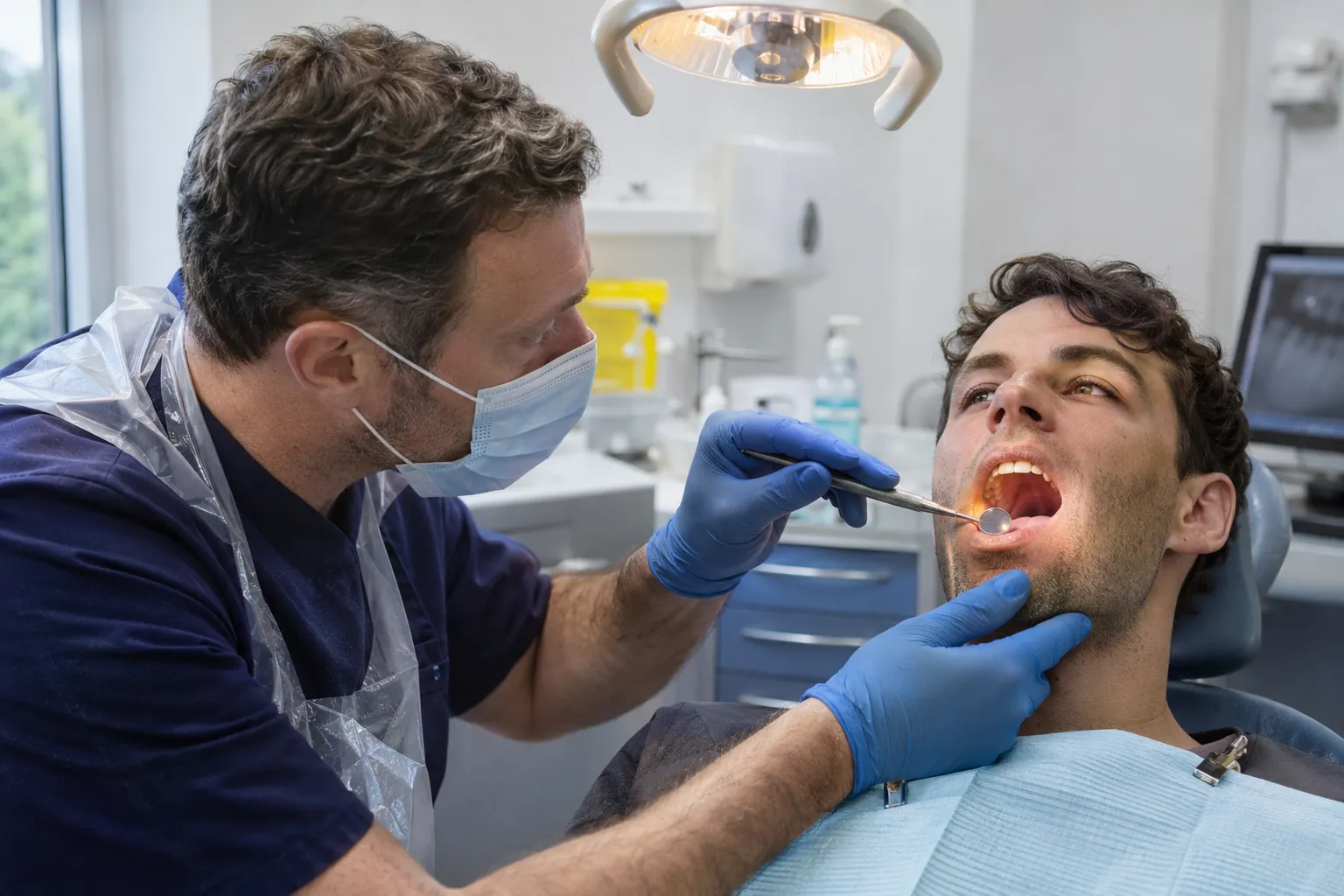
In the chair, sorting this out takes minutes. I look at the gum and the flap, press around the tooth, test it with cold and a gentle tap, check your jaw and cheek, and usually take an X-ray to see how the tooth is sitting and whether decay is hiding between it and its neighbour. You can't work this out from your sofa, and neither can Google. I can, usually in one visit.
When should I see a dentist about a sore gum or wisdom tooth?
My rule: a mildly sore gum with no swelling and no bad taste, or a tooth that twinges with cold and nothing else, can have a couple of days of careful cleaning and salt-water rinses while you book a normal appointment. The NHS says to see a dentist for toothache lasting more than two days, and I'd apply that to a sore gum too.
Call us today if:
- the gum over the tooth is swollen, or there's pus or a bad taste that won't shift
- your cheek is swollen, or your jaw is stiff or won't open fully
- the tooth throbs on its own, lingers after hot or cold, keeps you awake, or painkillers aren't touching it
- you have a temperature or feel unwell with it
- an ulcer has lasted more than three weeks
Call 999 or go to A&E, not a dentist, if: you're finding it hard to breathe, swallow or speak; swelling is spreading towards your eye or down into your neck; your eye is swollen or painful, or your eyesight has suddenly changed; or you can't open your mouth properly because of the swelling.
While you wait, the NHS suggests warm salt-water rinses (half a teaspoon of salt in a glass of warm water, rinse and spit), soft food, avoiding very hot, cold or sweet things, and ibuprofen or paracetamol if you can take them, never more than the recommended dose. Keep brushing the area gently, even if it bleeds a little.
If you're near Harlow or Enfield, I'd much rather take a look than have you spend another evening pressing the gum, then the tooth, then the gum again. Ring your nearest Minti practice. If it's throbbing or swollen, say it's urgent and we'll do our best to see you the same day. Anywhere else, or out of hours, call NHS 111.
This article is general information, not a diagnosis. Wisdom tooth pain needs examining in person to find the cause.