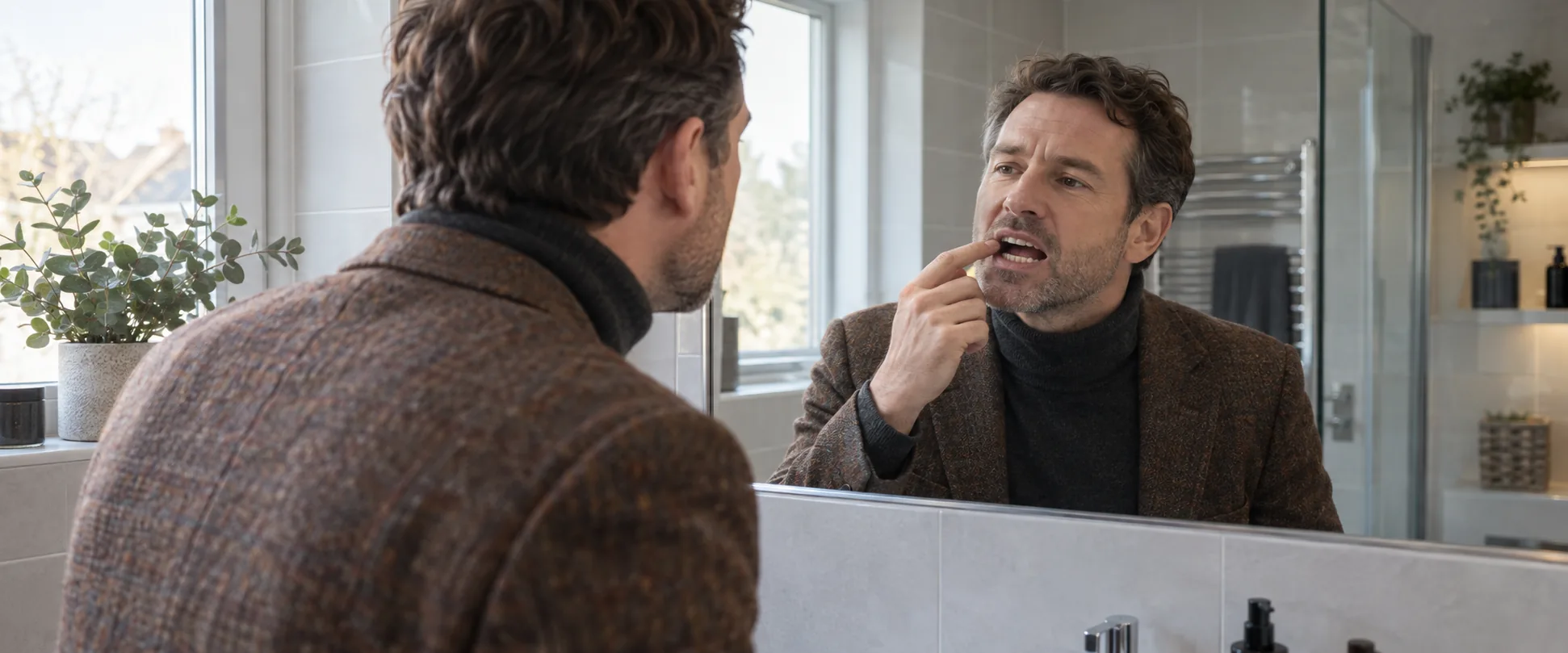
Let me guess. Something felt a bit off, so you tapped the tooth with a fingernail. Then a teaspoon. Then the end of your toothbrush, just to be sure. One tooth gave you a dull, bruised “ow” and the ones either side did nothing, and now you’re here. Everybody does this, and I don’t mind at all, because you’ve run the same test I would, just with worse equipment.
The short answer: a tooth that’s sore when tapped usually means the ligament holding it in its socket is inflamed. Think of it as a bruise you can only find by pressing on it. Sometimes the cause is small, like a filling sitting a touch too high. Sometimes it’s the first sign of an infection at the root. You can’t tell which from your bathroom, and you don’t have to. If it’s been sore for more than a couple of days, it hurts when you bite, or there’s any swelling, ring us. My emergency dentist team sees urgent patients in Harlow and Enfield. If we’re closed or you’re not local, call NHS 111. And if your problem is the opposite one, pain you can’t pin to any tooth at all, I’ve written a different article for that.
In pain right now? Call your nearest Minti practice and tell reception it’s urgent. I keep same-day appointments for pain and swelling wherever I can.
- Nuffield Dental Practice, Harlow: 01279 424 038
- Church Langley Dental, Harlow: 01279 306 690
- Enfield Smiles, Enfield: 020 8804 4320
Evening, weekend, or nowhere near us? Call NHS 111 and they’ll find you an urgent dental appointment. If you’re struggling to breathe or swallow, or swelling is spreading to your eye or neck, that’s 999 or A&E.
What does it mean when a tooth hurts when tapped?
Your teeth aren’t cemented into your jaw like fence posts. Each one is held in its socket by a thin ligament, and that ligament is packed with pressure sensors. It’s how you can tell, mid-sandwich, that there’s a single poppy seed between two teeth.
When that ligament is inflamed, a tap squeezes it, and it objects. Same principle as a bruise on your shin: you can forget it’s there until something knocks it. So a tooth that’s tender to tapping is telling me the problem is around the root, not just inside the tooth. I find that useful, because it’s a different message from the sharp zing of a sensitive tooth with a cold drink.
What the tap can’t tell you is why the ligament is upset. That’s the bit that needs me, and there are a handful of usual suspects.
Could inflammation around the root cause it?
Yes, and in my experience it’s the most common reason. Dentists call it apical periodontitis, which is a mouthful that just means inflammation around the tip of the root. The typical pattern is a tooth that’s tender to tap, hurts when you bite, and may feel slightly “high”, as if it’s hitting first when you close your teeth together. It genuinely can be. The inflamed ligament can lift the tooth a fraction in its socket, and your bite notices.
What sets it off varies, and they’re not all sinister:
- A new filling or crown that’s a touch too high. Your bite is the princess and the pea of the human body. A high spot of less than a millimetre is enough to make one tooth take the full force of every chew, and the ligament complains. The good news is that easing the high spot is a quick job, and the soreness usually settles once it’s done.
- Clenching or grinding. If your teeth are doing a night shift you never signed them up for, the ligaments take the strain.
- A knock. A stray elbow at five-a-side or an argument with a fork can bruise the ligament, sometimes without chipping anything.
- A crack. Cracked teeth tend to give a sharp pain on biting, or just as you let go, and often hate the cold.
- The nerve inside the tooth is in trouble. When deep decay or an old, leaking filling lets bacteria reach the nerve, the inflammation eventually spills out of the root tip into the ligament. This is the one I most want to catch early.
One odd one out. If several upper back teeth on one side are all tender to tap, you’ve had a cold, and it’s worse when you bend forward, the culprit may be your sinuses rather than any tooth. Your upper back teeth and your sinuses are close neighbours, and teeth get blamed for a lot they didn’t do.
Could it be an infection?
It could, and I’ll be straight with you about this part. If bacteria have got into the nerve of the tooth, the infection can collect at the root tip as an abscess, which is a pocket of pus. A tooth with an abscess is usually very tender to tap and to chew on. It often comes with a deep, throbbing ache, and sometimes a bad taste, a swollen gum or face, or a temperature. An abscess can also start in the gum beside a tooth rather than inside it.
Two things I want you to know. First, a dental abscess won’t go away by itself. Second, antibiotics alone don’t fix it, because they can’t remove the source. The real treatment is dealing with where the infection lives, which usually means draining it, then either root canal treatment to save the tooth or taking the tooth out. Antibiotics have their place if the infection is spreading or you’re unwell with it. All of that is done with you properly numb, and I can’t tell you which option is right until I’ve examined the tooth.
And a trap to avoid: a tooth that throbbed badly and then went quiet hasn’t necessarily healed. It can mean the nerve has died, and the infection carries on at the root without the alarm bell. If that’s your tooth’s history and it’s now sore to tap, that’s a call-this-week situation, not a wait-and-see one.
Why dentists tap teeth during an examination
In a room full of X-ray machines and scanners, one of the most useful things I own is the handle of a mirror. We call it a percussion test, which sounds grander than it is. I tap.
There’s method to it, though. I start on teeth I’m fairly sure are fine, so you and I both learn what normal feels like in your mouth. They’re the control group. Then I work my way along to the suspect. A healthy tooth gives a shrug. A tooth with an inflamed ligament gives an unmistakable “that one”.
It’s useful precisely because it answers a different question from everything else. A cold test tells me how the nerve inside the tooth is doing. The tap tells me about the tissues around the root. Put the two together with a bite test and an X-ray and the picture usually comes into focus. Tooth that overreacts to cold and is sore to tap? The nerve is inflamed and it’s spreading. Tooth that ignores the cold completely but jumps when tapped? That nerve may have died quietly, and the trouble has moved to the root.
This is also why your teaspoon, however carefully deployed, only gets you halfway. You’ve found the “where”. I need the other tests for the “why”.
What if the tooth only hurts when tapped but feels normal otherwise?
This is more common than you’d think, and it’s the version where several answers are honestly possible. It might be the mild end of things: a recent filling that’s slightly proud, a spell of clenching during a stressful month, a knock you’ve half forgotten, or your sinuses after a cold. Those often settle, especially once the cause is sorted.
But “feels fine unless I tap it” isn’t proof that all is well. Long-standing inflammation at a root tip can be completely painless, and plenty of it is only ever spotted on a routine X-ray. A tooth can be quietly in trouble without sending you a single memo.
So here’s what I’d suggest. First, stop tapping it. I know. But checking every twenty minutes tells you nothing new and keeps prodding a sore spot. If there’s an obvious recent cause, like new dental work, ring the practice that did it, because adjusting a bite is a short, simple visit, and no dentist minds doing it. If it’s still tender after a few days, or there’s no obvious reason, book an ordinary appointment. No blue lights needed, but don’t leave it for months either.
When should you get it checked?
Nobody hands out medals for putting up with toothache. The NHS advice is to see a dentist if tooth pain lasts more than two days. Call sooner, today if you can, if:
- it hurts to bite or chew on that tooth, or it’s throbbing
- painkillers aren’t touching it, or it’s keeping you awake
- you’ve got a high temperature, a bad taste in your mouth, or a swollen gum, cheek or jaw
- it started after a knock to the face or teeth
Call 999 or go to A&E, not a dentist, if:
- you’re finding it hard to breathe, swallow or speak
- swelling is spreading towards your eye or down into your neck
- you can’t open your mouth properly because of the swelling
While you’re waiting to be seen, ibuprofen or paracetamol (as per the packet), soft food, chewing on the other side and avoiding anything very hot or very cold will take the edge off. They won’t fix the cause, so don’t let one good afternoon talk you out of making the call.
If you’re near Harlow or Enfield and that tooth is getting more tender rather than less, I’d much rather take a look than have you spend another evening tapping it with cutlery. Ring your nearest Minti practice, say it’s urgent if it is, and we’ll do our best to see you the same day. The numbers are at the top of this page and on my emergency dentist page. If it’s one for a routine visit, my dental check-up page has the details. Anywhere else, or out of hours, call NHS 111.
This article is general information, not a diagnosis. Tooth pain needs examining in person to find the cause.