By Dr Nishma Kotecha, dentist
Tom Cruise has hung off the side of a plane, climbed the tallest building in the world and sprinted through more films than anyone can count. This week, the American Film Institute announced he'll receive its 2027 Life Achievement Award, one of the biggest honours in Hollywood (here's the AFI's own announcement).
So naturally, I want to talk about his braces.
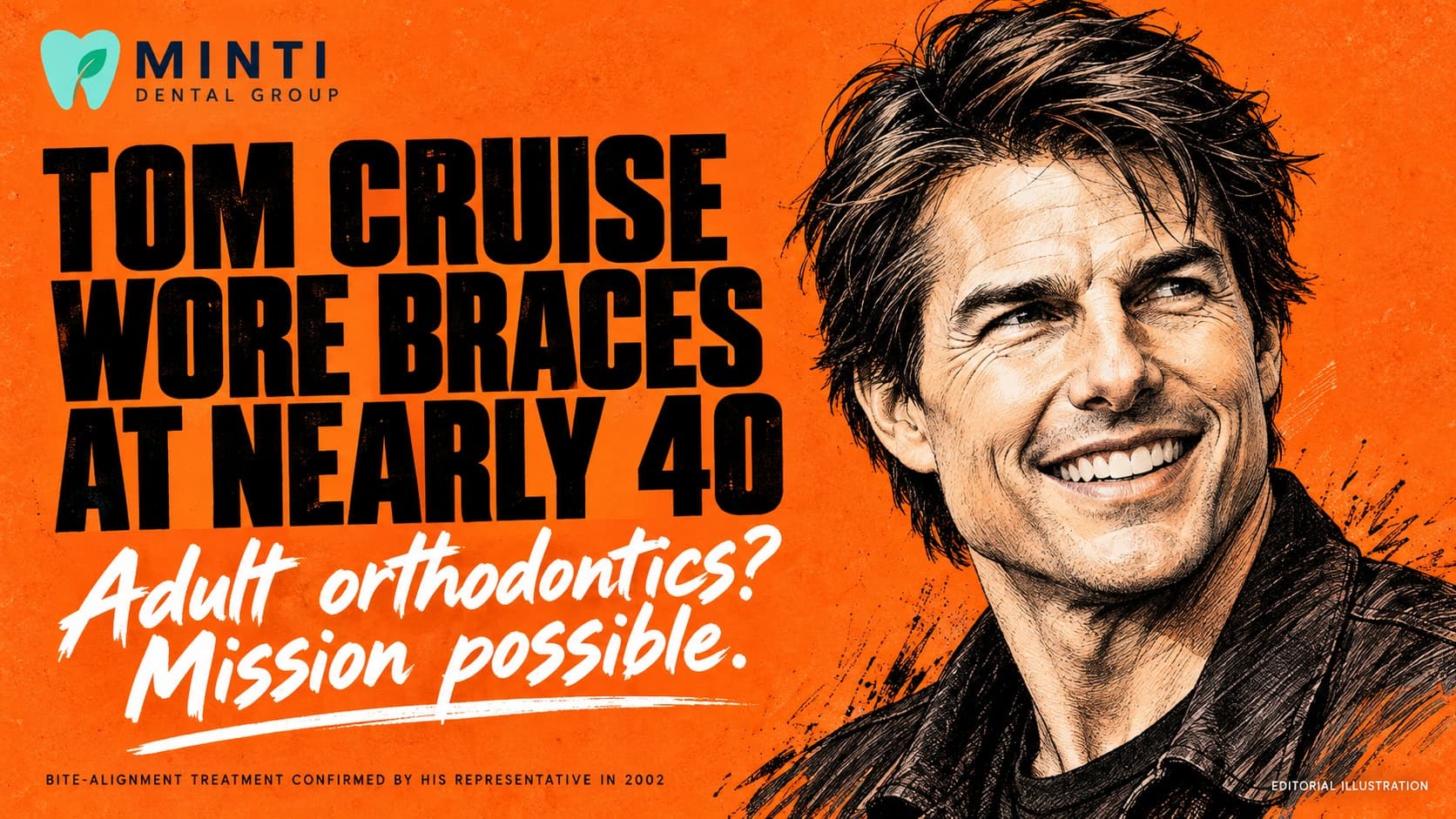
Because back in 2002, when he was just a few months off his 40th birthday, Tom Cruise had braces fitted. Not as a teenager. Not quietly between films. In the middle of one of the most famous careers on the planet.
The short answer: in February 2002, Tom Cruise's representative confirmed he'd had braces fitted to correct how his upper and lower teeth met, and that he'd likely wear them for "a year or so". He was 39. It's one of the clearest celebrity examples that age alone doesn't rule out orthodontics. If your teeth and gums are healthy, teeth can be moved at any age. (I've written a full guide to straightening teeth as an adult, and if you'd rather something less visible, here's how Invisalign works. You'll also find a few more famous faces in the royals who wore braces.)
What did Tom Cruise's team actually say?
According to a Deseret News report from 23 February 2002, his publicist at the time, Pat Kingsley, confirmed it plainly: "Yes, Tom Cruise has braces. I don't know what else to say."
The braces had gone on about a week earlier. The aim was to correct how his top and bottom teeth came together, in other words, his bite. He was expected to wear them for "a year or so". And Kingsley added two lines I love: "He'll take them off for movies," and "To him, it's no big deal."
The report described them as see-through braces, though a wire was clearly visible across his upper teeth. Beyond that, we don't know exactly what system he had, and I'm not going to guess.
I also want to be clear about what this story isn't. It's not evidence of veneers, whitening or anything else. There's been plenty of speculation about Tom Cruise's teeth over the years, but the braces are the bit that was actually confirmed. (If you're curious, I've also written about Tom Cruise's teeth and a rather different dental moment.)
Why would someone have braces for their bite?
When most people think about braces, they think about straightening crooked front teeth. But orthodontics isn't only about looks.
Your bite is how your upper and lower teeth meet when you close your mouth. Ideally, they fit together a bit like a well-made zip. When they don't, it can mean some teeth take more pressure than they should, teeth wear unevenly, or chewing is less efficient.
The British Orthodontic Society notes that the way the teeth bite together matters, and that poorly managed treatment can cause problems like teeth biting into the roof of the mouth or meeting less efficiently. That's why a proper orthodontic plan looks at how your teeth work together, not just how they look from the front.
So when Tom Cruise's team said his braces were about how his upper and lower teeth met, that's a very ordinary, very sensible reason for treatment, whether you're a Hollywood star or not.
Is there an age limit for braces?
No. This is the myth I'd most like to bust.
The British Orthodontic Society is clear: teeth can be moved at any age, as long as the teeth and gums are healthy. It also notes that more and more adults are seeking orthodontic treatment.
What matters isn't how old you are. It's:
- How healthy your gums are. Moving teeth through inflamed gums is a bad idea, so gum disease needs sorting first.
- The condition of your teeth. Decay, large fillings or crowns can all affect the plan.
- What needs correcting. Mild crowding might be simple. Bigger bite problems can need more complex treatment.
- Your commitment. Adults are often brilliant patients because they've decided they want it.
If anything, adults often get a wider choice of brace styles than teenagers, because adult treatment in the UK is usually private.
What are the options for adults?
If you're thinking, "I'd love straighter teeth, but I'm not walking into a board meeting with a mouth full of metal," good news. You've got choices.
- Metal fixed braces. The classic. Very effective, usually the most affordable fixed option.
- Ceramic braces. The BOS describes them as tooth-coloured or translucent brackets. Less noticeable than metal, though they can discolour over time, can be more prone to breaking, and usually cost more.
- Braces behind the teeth. Fixed to the inside surfaces, so they're almost invisible from the front, but they can affect speech and the tongue at first.
- Clear aligners. Removable clear plastic trays. The BOS says they work well for mild alignment problems but are less suitable for more severe cases. They're what Maura Higgins used before her bonding.
Which one suits you depends on what your teeth need, not just what looks most discreet.
What does Tom Cruise's story teach us?
Three things, really.
First, it's never "too late". He was 39, at the height of his fame, and he still went for it.
Second, braces don't have to stop your life. His team said he'd take them off for films, but otherwise he carried on. Premieres, press, public appearances. The vast majority of adults with braces carry on working, socialising and living normally.
Third, it's about function as well as looks. His braces were about his bite. A lot of adults come to orthodontics for cosmetic reasons, but how your teeth meet can matter just as much as how they look.
Braces are not the same as veneers
Every time a celebrity's smile changes, the internet shouts "veneers". But braces and veneers do completely different jobs.
Braces move your natural teeth into a better position. Nothing is filed down and nothing is stuck on top. Your teeth stay your own.
Veneers are thin coverings fixed to the front of teeth to change how they look. They don't move anything, and many involve removing some natural enamel first. (And they're not the same as crowns either, as I explained in veneers vs crowns.)
So if your teeth are a good shape and colour but sit in the wrong place, straightening them is often the gentler option to look at first.
Don't forget the retainer
The end of braces isn't really the end. The BOS says teeth tend to return to where they came from once treatment finishes, and that it can take at least a year for the jawbone and gums to settle. Its advice is long-term retention, and it notes that lifelong retainer wear may be needed to keep teeth in their new place.
That's especially relevant for adults, because teeth naturally shift a little throughout life anyway. If you've noticed this already, I've explained more in why are my teeth moving?.
The NHS guide to braces also covers the basics of how they work and why retainers matter afterwards.
A few quick questions
Did Tom Cruise have braces? Yes. In February 2002, his representative confirmed he'd had braces fitted to correct how his upper and lower teeth met.
How old was Tom Cruise when he got braces? He was 39, a few months before his 40th birthday.
Can adults get braces? Yes. The British Orthodontic Society says teeth can be moved at any age, as long as the teeth and gums are healthy.
Are there discreet braces for adults? Yes. Options include ceramic braces, braces fitted behind the teeth and clear aligners, each with their own pros and cons.
The verdict
Tom Cruise has done things on screen that most of us would never dream of. But one of the most relatable things he's ever done was wear braces at 39 and treat it as "no big deal".
If you've been telling yourself you've left it too late to straighten your teeth, you probably haven't. Get your teeth and gums checked with a check-up, ask the right questions, and keep wearing that retainer afterwards. Mission very possible.
This article is general information based on public reporting. It is not personal dental advice. Tom Cruise and the American Film Institute have no connection with this article.