You've got a filling booked and a diary that won't move. Can you squeeze it into a lunch break? Do you need to tell your boss you'll be "working from home" for the afternoon? It's one of the most common things I hear in my surgery, usually asked while someone is already checking their watch.
The short answer: a single, straightforward filling usually fits comfortably inside one normal appointment, and a good chunk of that time is waiting for the tooth to go numb. Bigger fillings, several fillings, back teeth and white fillings take a bit longer, and the numbness hangs around for a few hours after you leave. Fillings are an everyday part of my work: I find what needs doing at your dental check-up, tell you how long it will take, and we book the right length of appointment. If the tooth is already throbbing, keeping you awake or your gum is swollen, don't wait for a routine slot: call my emergency dentist team in Harlow or Enfield, or NHS 111 if we're closed. For the full picture, see my tooth fillings guide.
Need a filling booked in, or is the tooth already hurting? Call your nearest Minti practice and tell reception what's going on. I keep same-day appointments for pain and swelling wherever I can.
- Nuffield Dental Practice, Harlow: 01279 424 038
- Church Langley Dental, Harlow: 01279 306 690
- Enfield Smiles, Enfield: 020 8804 4320
Evening, weekend, or nowhere near us? Call NHS 111. If you're struggling to breathe or swallow, or swelling is spreading to your eye or neck, that's 999 or A&E.
How long does a single filling take?
For a small, simple filling, the drilling and filling part is quicker than most people expect. What takes the time is everything around it: saying hello, the numbing injection, giving it a few minutes to work, then the tidy-up and bite check at the end.
I won't give you a stopwatch figure, because there isn't an honest one that fits every tooth. A tiny filling on the side of a front tooth and a big one across the back of a molar are different jobs, a bit like "how long does it take to paint a room?" A downstairs loo and a loft conversion both count. What I do is look at the tooth at your check-up and tell you then.
If you're nervous, tell reception when you book. A little extra time means nobody's rushing, least of all me.
What happens during a filling appointment?
Here's the running order, so nothing comes as a surprise:
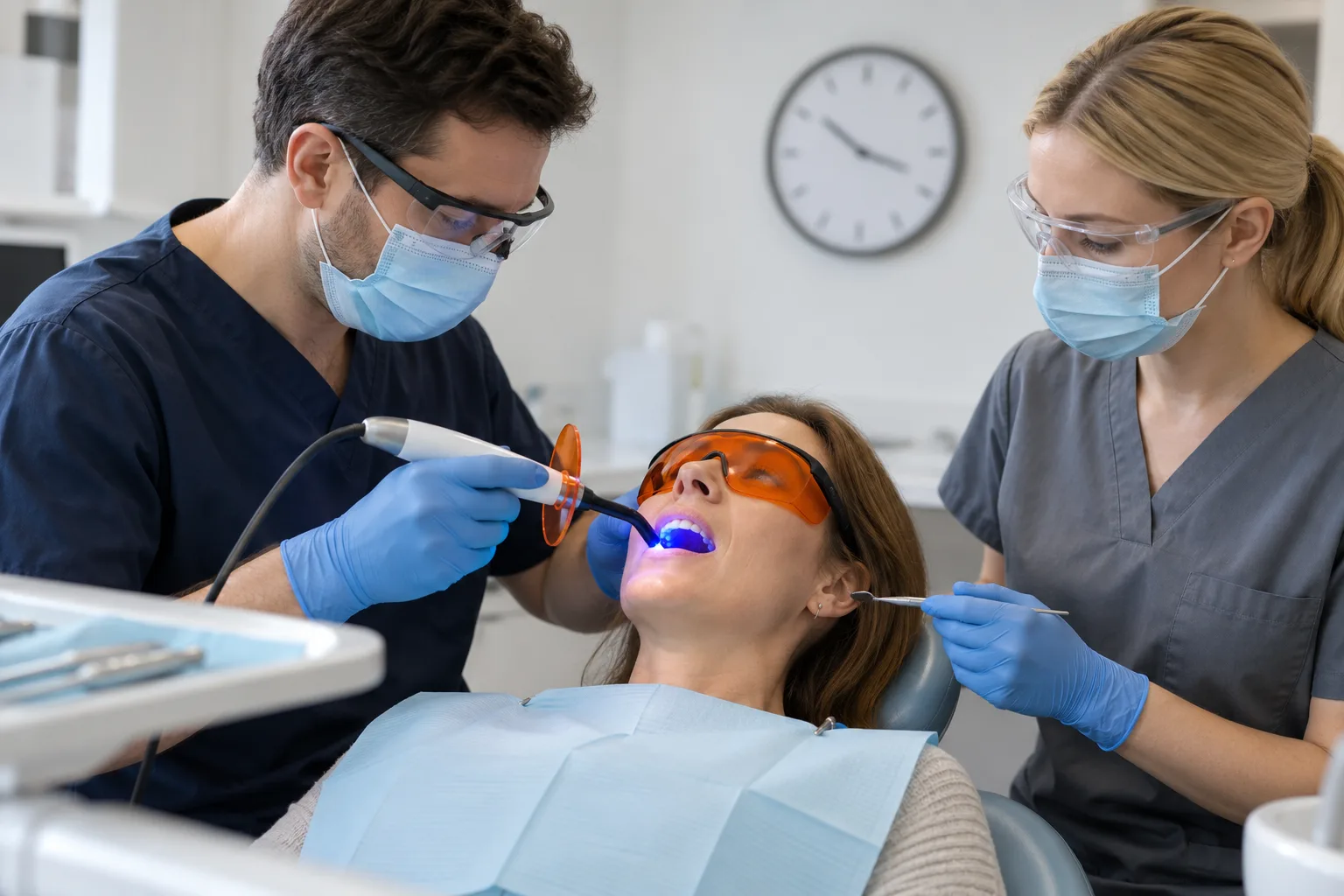
- Numbing. A local anaesthetic injection, often after a dab of numbing gel. Then a few minutes' wait while it works.
- Removing the decay. I clean out the soft, decayed part of the tooth and shape the space so the filling will stay put.
- Filling. The material goes in. White (composite) filling material is built up and set hard with a blue light, a few seconds at a time. Silver (amalgam) is packed in and shaped.
- Polish and bite check. I smooth the edges and ask you to bite on thin coloured paper, so I can make sure the filling isn't sitting too high.
A filling that's a whisker high can make the tooth sore every time you bite. I've done it myself, and every honest dentist has. If your bite feels off once the numbness wears off, come back and I'll adjust it; I've written about a filling that feels too high.
Worried it'll hurt? See do fillings hurt?
Why do some fillings take longer than others?
A few things decide how long you'll be in the chair:
- Size and depth. A small hole is a small job. Decay that has spread further means more to clean out and more to rebuild, and a deep one close to the nerve needs extra care.
- Where the tooth is. Back teeth are harder to reach and keep dry. Fillings between two teeth need a thin band wrapped round the tooth to shape the side properly.
- The material. White fillings take a few extra minutes compared with silver ones, because they're built up and set in layers and the tooth has to be kept very dry while I work. Amalgam is quicker to place. I've compared the two in white vs amalgam fillings, and there's a third, glass ionomer, that's used in particular spots.
- How numb you get. Some teeth, especially lower back ones, can take a little longer to go fully numb. If I need to top up the anaesthetic, I will. I'd rather lose five minutes than have you feel a twinge.
Here's the part I say to everyone: the earlier a filling is done, the smaller and quicker it tends to be. Decay doesn't wait politely for a convenient week.
Can you have more than one filling in one visit?
Often, yes, especially if the teeth are on the same side and can be numbed with the same injection. That's usually the most efficient way: one lot of numbing, one numb lip, one afternoon of drinking your tea carefully.
If several fillings are spread around your mouth, I may split them into two or more visits. Being numb on both sides at once is nobody's idea of a good lunch. It's something I plan with you at your check-up, based on your diary as well as your teeth.
On the NHS, fillings are part of Band 2, and if you need further treatment in the same band within two months, the NHS says you don't pay again. So splitting a course of fillings over a couple of visits shouldn't cost you more. I've explained the charges in how much is a filling on the NHS? and private fees are on our fees and finance page.
How long will you be numb afterwards?
This is the bit that really eats into your day. The filling is finished when you leave, but your lip, tongue or cheek can stay numb for a few hours.
While you're numb, it's easy to bite your cheek or burn your mouth without noticing, so go carefully. The NHS advice after a local anaesthetic is to move carefully until it has fully worn off. That's why I'd avoid booking a filling right before a big presentation or a dinner out. Your mouth will work. Your smile might be a bit lopsided.
For the practical details, I've covered how long after a filling you can eat and when you can have tea, coffee or alcohol.
When should you book, and when is it urgent?
If a filling was found at your check-up and nothing hurts, book it in the normal way, and don't leave it for months. A small filling today is a quicker appointment than a big one next year.
Call us today if:
- the tooth throbs by itself, keeps you awake, or painkillers aren't helping
- pain lingers for a long time after hot or cold
- a filling has fallen out or feels loose, or the tooth has broken
- the gum near the tooth is swollen, or there's a bad taste
The NHS says toothache lasting more than two days needs a dentist, so don't sit on it.
Call 999 or go to A&E, not a dentist, if:
- you're finding it hard to breathe, swallow or speak
- swelling is spreading towards your eye or down into your neck
- your eye is swollen or painful, or your eyesight changes suddenly
- you can't open your mouth properly because of swelling
Until you're seen, the NHS advice for toothache is paracetamol or ibuprofen if you can take them, and avoiding very hot, cold or sweet food on that side.
If you're near Harlow or Enfield, I'd much rather take a look and give you a proper time estimate than have you guess and block out the whole day. Ring your nearest Minti practice to book. If the tooth is already hurting, say it's urgent and we'll do our best to see you the same day. Anywhere else, or out of hours, call NHS 111.
This article is general information, not a diagnosis. Tooth pain needs examining in person to find the cause.