You're stood in the pharmacy aisle, holding a little box that promises to fix your tooth for the price of a meal deal. In your mouth is a hole. In your head is the question: do these things actually work? You're not the only one asking. I'll give you the answer I'd give you across the chair rather than the one on the box.
The short answer: yes, for what they're designed to do, which is less than you're hoping. A temporary filling kit can cover an open hole, take the edge off cold and sweet sensitivity and stop a sharp edge shredding your tongue until you can be seen. What it can't do is treat the decay, crack or failed cement that made the filling fall out, and it isn't built to last. UK dental guidance says the same thing in politer words: a pharmacy repair kit is an interim measure until you're seen. So use one if it helps, then book. If the tooth isn't hurting, a normal appointment in the next week or so is fine. If it is hurting, swelling, or a piece is wobbly, skip the kit and ring my emergency dentist team in Harlow or Enfield, or NHS 111 if we're closed. My lost filling guide and the broken tooth and lost filling hub cover the rest.
Hole in a tooth and not sure whether to patch it or ring? Call your nearest Minti practice and describe it. I keep same-day appointments for pain and swelling wherever I can.
- Nuffield Dental Practice, Harlow: 01279 424 038
- Church Langley Dental, Harlow: 01279 306 690
- Enfield Smiles, Enfield: 020 8804 4320
Evening, weekend, or nowhere near us? Call NHS 111. If you're struggling to breathe or swallow, or swelling is spreading to your eye or neck, that's 999 or A&E.
What's actually in a temporary filling kit?
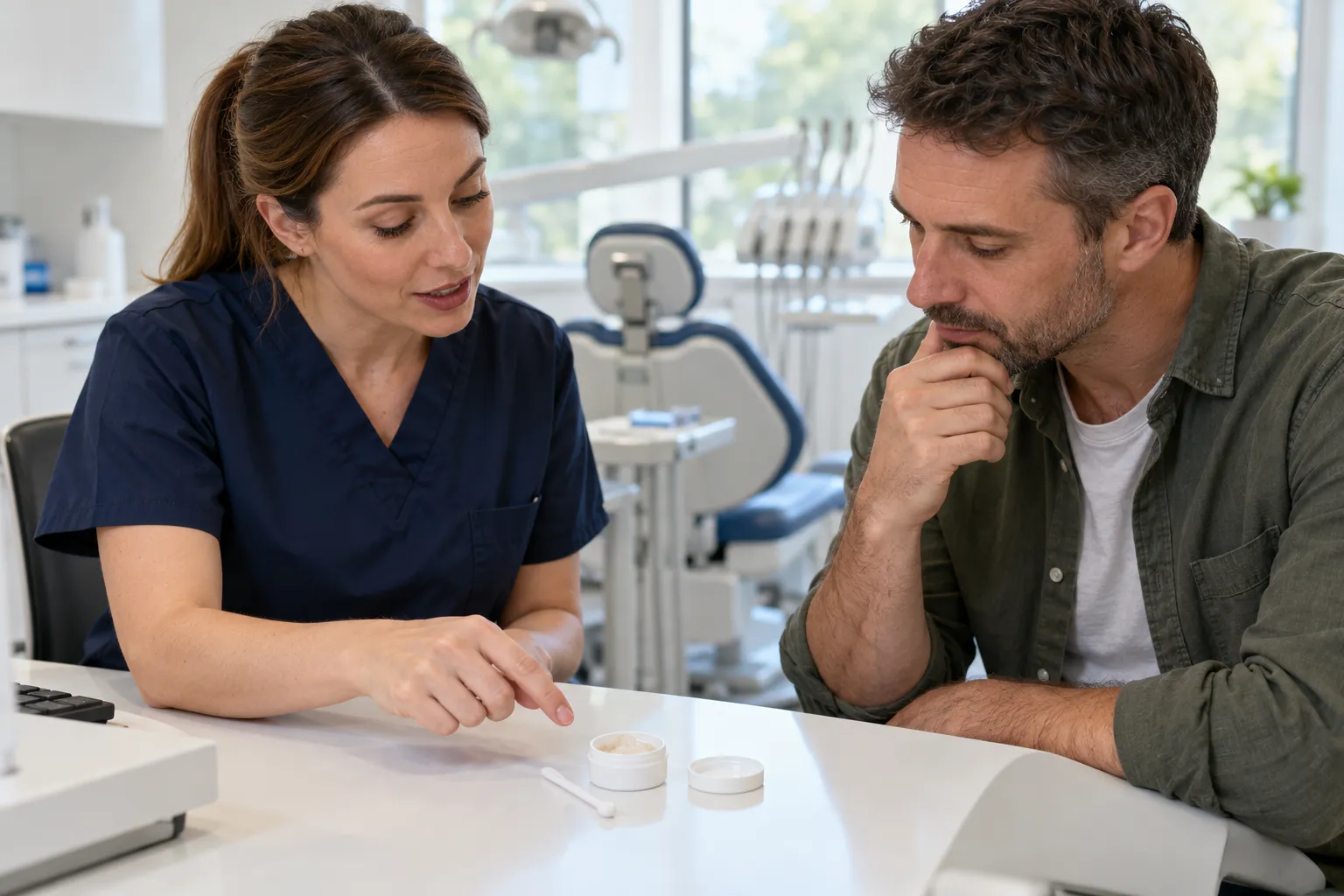
Most pharmacy kits are a small tub or tube of putty that you press into the hole with a little plastic tool, and it sets in your mouth. The exact recipe varies by brand, so the packet is the boss, not me. The classic temporary material dentists have used for decades is zinc oxide mixed with eugenol, which is the active bit of clove oil. That's why some kits smell like Christmas. Eugenol has a mild numbing effect on the tooth, which is where the "instant relief" claims come from.
Here's the thing to understand about that material: it's designed to be temporary. It's soft compared with a real filling, it wears, and it slowly dissolves in saliva. That's the point; a temporary is meant to come out easily later. You just need to know that "temporary" is doing a lot of work in the name.
Do they work?
Let me split "work" into the three things people actually mean.
- Will it stop the sensitivity? Often, at least partly. Covering the exposed inside of the tooth stops cold and sweet getting at the nerve, in the same way a plaster stops a graze stinging in the wind. That's real relief.
- Will it stop the sharp edge cutting my tongue? Usually yes, and this is one of the best uses. Anything that stops an ulcer forming on your tongue or cheek is worth doing.
- Will it fix the tooth? No. This is the bit the box is quiet about. Fillings come out because of decay, a crack, or cement that has given up. The putty sits on top of that problem. It doesn't clean it out, and it doesn't seal it the way a proper filling does.
So my verdict, and it's the advice I give in the chair: a kit is a decent plaster and a rubbish repair. Use it as the former. Never mistake it for the latter.
When is a kit a sensible stopgap, and when should I skip it?
A kit is a reasonable idea when the tooth isn't really hurting, the hole is easy to see and reach, and you've already got an appointment booked or you're about to book one. That's the scenario the guidance has in mind: something to keep the tooth going until you're seen.
Skip the kit and ring instead if:
- the tooth is throbbing, aching on its own, or keeping you awake, because a putty on top of an inflamed nerve is not going to sort that and you need seeing urgently
- painkillers taken as the packet says aren't controlling the pain
- there's swelling of the gum or face, a bad taste, or you feel unwell
- a piece of tooth is loose or wobbly; you shouldn't pack putty around something that's about to come away
- you can't see the hole properly, because you can't fill what you can't see
Also, and I'll keep this bit straight: if you think you may have breathed in a piece of tooth or filling rather than swallowed it, that's emergency care, not a pharmacy trip.
How do I use one without making things worse?
Follow the packet. Brands differ. On top of that, a few things I'd add:
- Clean and dry the tooth first. Rinse, then dab the hole dry with a bit of tissue. Putty grips a dry tooth far better than a wet one.
- Don't overfill. If the putty sits proud, you'll bite on it first and the tooth will get sore from taking all the force. Less is more.
- Don't chew on that side. Even after it's set, it's soft compared with a real filling.
- Keep eugenol off your gums and cheek if the kit contains it. It can sting soft tissue, and a few people are allergic to it. If your mouth stings or swells, take it out.
- Keep brushing. Twice a day with fluoride toothpaste, gently over the patch. A dirty patch is worse than no patch.
Expect it to crumble, wear or fall out eventually. That's the material behaving as designed, not a sign you did it wrong.
What will I do that a kit can't?
The difference isn't the putty. It's the looking. When you come in I'll check whether the tooth is tender to bite on, test how the nerve is responding, and usually take a small X-ray to see what's underneath. That tells me why the filling failed, which is the bit the kit skips entirely. Then I can clean out any decay and put in a proper filling, or place a dental temporary that calms the nerve while I plan something more solid, or talk to you about a crown if the tooth has lost too much of itself to hold a filling. You can't tell which of those you need from the pharmacy aisle. I can, usually in one visit.
When should I stop patching and ring?
My rule: a kit buys you days, not weeks. If you've patched it once and you're now on your second tub, the tooth is telling you something. Call us today if:
- the tooth starts hurting on its own, lingers after hot or cold, or wakes you up
- the gum around it swells, there's a bad taste, or you have a temperature
- the patch keeps falling out and the edge is cutting your tongue or cheek
- more of the tooth has broken away
Call 999 or go to A&E, not a dentist, if:
- you're finding it hard to breathe, swallow or speak
- swelling is spreading towards your eye or down into your neck
- you can't open your mouth properly because of the swelling
- you think you've breathed in a piece of tooth or filling (coughing, wheezing or chest discomfort since it went)
Until you're seen: soft food, chew on the other side, and a smear of sensitive toothpaste on the tooth if it's twingeing.
If you're near Harlow or Enfield, I'd much rather take a look than have you on your third box of putty. Ring your nearest Minti practice, tell us what's happened, and if it's painful say so and we'll do our best to see you the same day. Anywhere else, or out of hours, call NHS 111.
This article is general information, not a diagnosis. Tooth problems need examining in person to find the cause.